
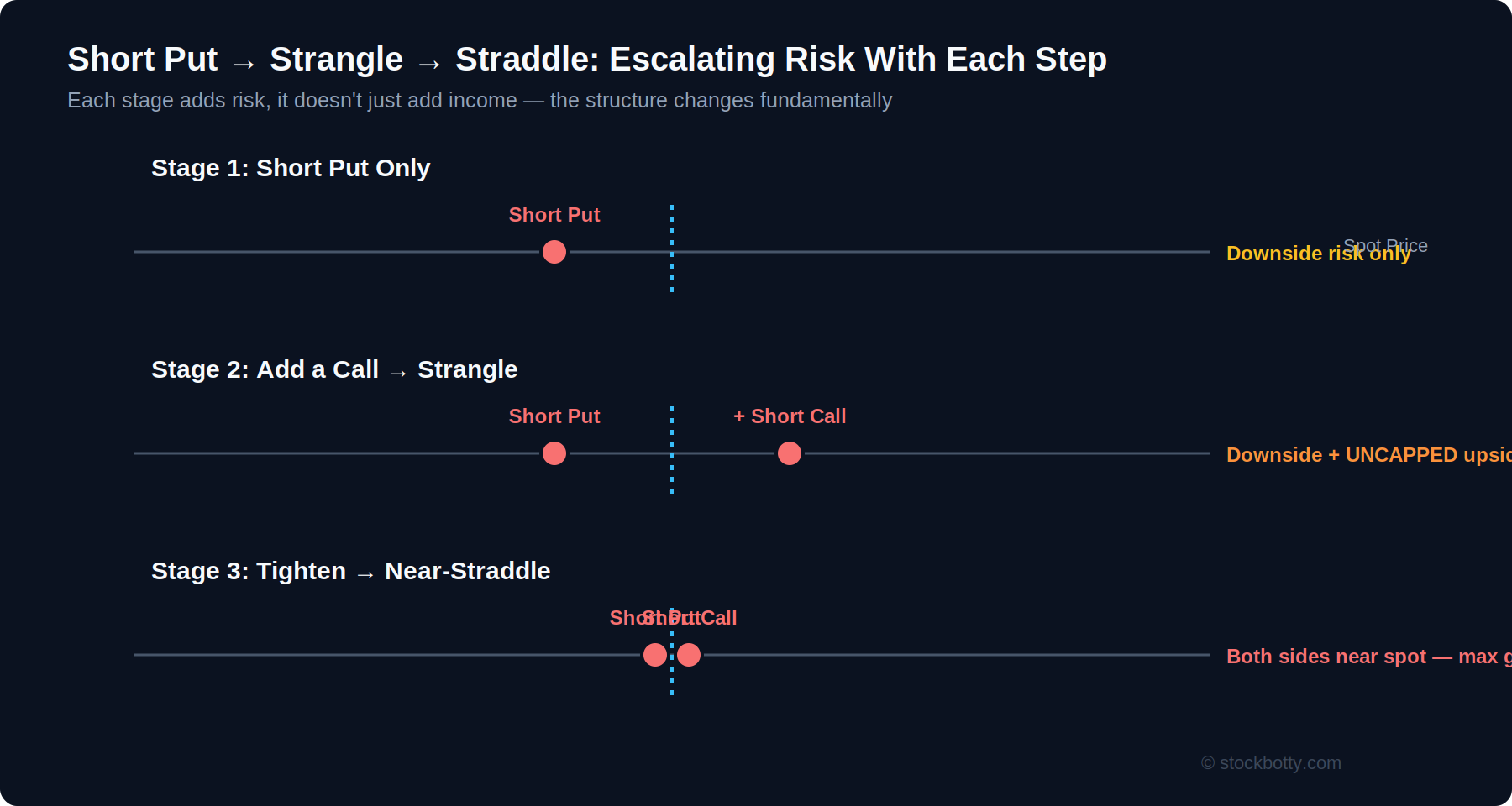
⚠⚠ This is the most aggressive technique in this Playbook – read carefully before anything else. Everything else in this series repositions risk that already existed. This one is different: I deliberately add a new, uncovered short call – with theoretically unlimited risk – on top of a position that’s already losing, and I deliberately move both strikes closer to the current price, which increases the odds that either side gets tested. This is not a rescue in the sense of reducing risk. It’s a bet that the stock calms down and trades sideways, made with more capital exposure than the trade started with. This is a record of what I’ve done, not a recommendation, not financial advice, and not something I’d suggest for anyone without a clear understanding of undefined risk on both sides of a stock’s price at once.
Everything else in this Playbook is about defending a position that’s still fundamentally the same trade – a rolled put is still a put, a rescued covered call is still a covered call. This one is different. When a short put of mine has moved deep into a loss and I still believe the stock will settle down rather than keep falling, I’ve sometimes turned it into a strangle by selling a call against it, and then tightened both strikes toward the current price to collect more premium. It’s aggressive, it adds real risk that wasn’t there before, and I want to walk through exactly why before getting into how.
My Starting Position
Stock trading at $100. I sell the $95 put, 45 days out, for $2.00 ($200 collected). The stock drops hard to $85. My put is now worth roughly $11.50, an unrealized loss of about $950 – well past the “act now” territory I described in my short put adjustment framework. This is the kind of position where rolling down and out alone doesn’t feel like enough to me, and where I’ve considered this more aggressive approach instead.
Step 1: I Add a Call to Build a Strangle
I sell the $100 call, 45 days out, for $1.10 ($110 collected). I now hold a short put at $95 and a short call at $100 – a strangle. This call has nothing covering it. I don’t own the stock, so if the stock rallies hard, this call’s risk is genuinely uncapped, the same way any naked short call’s risk is uncapped. I’m not doing this to hedge the put – I’m doing it because I’ve decided I want to collect more premium while I wait for the position to (hopefully) recover, and I’m accepting new risk to do that.
Step 2: I Tighten Toward a Straddle
Weeks later, the stock has stabilized and recovered somewhat, sitting around $92. If I think the stock has found a range, I might decide to tighten further: I buy back the $100 call for around $0.40 (its value has shrunk as the stock stayed below it) and sell a new call much closer to the money – the $95 call – for $2.50, since it’s now worth far more sitting near the current price. Net credit on this roll: $2.10 ($210).
I’m now short the $95 put and short the $95 call – effectively a straddle, both legs sitting right at the current price. Total premium collected across every step so far: $200 + $110 + $210 = $520. That’s meaningfully more income than the original short put alone generated, and it’s built on a structure with far more risk than the original short put alone carried.
Why I’d Even Consider This
The honest reason is theta and premium. Options are worth the most, and decay the fastest, at the money. Tightening toward a straddle maximizes both the premium I collect and the daily time decay working in my favor, if the stock actually stays roughly where it is. This only makes sense to me when my view has shifted from “I think this stock goes up” (my original thesis when I sold the put) to “I think this stock is done moving for a while” – a completely different bet than the one I started with.
When This Stops Working
This is the section I take most seriously on this entire site, because this technique has the least margin for error of anything in this Playbook:
- If the stock breaks out sharply higher, my short call – now sitting close to the money on purpose – has uncapped risk, and I no longer have the built-in ceiling that a covered call or a vertical spread would give me. This is the single biggest change from every other technique in this series: I’ve introduced risk that has no defined maximum.
- If the stock breaks down sharply again, my put resumes losing value quickly, on top of whatever unrealized loss I was already carrying, and the tightened strike means less room before it’s tested again.
- Tightening the strikes doesn’t reduce my risk – it concentrates it. Moving both legs closer to the current price increases the premium I collect, but it does that specifically by increasing the probability that a normal-sized move in either direction breaches one of my strikes. I’m trading a wider, calmer structure for a narrower, more sensitive one.
- This entire approach depends on a thesis I have to get right twice. I was wrong about direction when I sold the original put (or the stock moved against me regardless). This technique requires me to then be right about volatility calming down – a second, independent bet layered on top of a position that already didn’t go to plan.
- My capital and margin requirements are the highest of anything in this Playbook. A naked strangle or near-straddle requires meaningfully more margin than a single short put, and that requirement can increase further if the stock moves against either side before I can react.
⚠ Risks Beyond the Basics
Beyond the core risk already covered above, a few mechanical details I keep in mind.
Gamma risk is elevated on both sides simultaneously
With both strikes near the money, the gamma dynamics covered on the Greeks page apply to both legs at once, not just one. A fast move in either direction can swing my position’s value quickly, and I have exposure to that on the put side and the call side at the same time.
Assignment risk applies to both legs, in both directions
Early assignment on the short put means I could be forced to buy shares; early assignment on the short call, if I somehow ended up covered by shares from the put side, could force me to sell them. If I’m not covered, the call side is a straightforward naked short with the risks that come with that.
Repeating this cycle compounds the risk further
If one side of the near-straddle gets tested, I’ve sometimes been tempted to repeat this whole process – add more premium, tighten further – rather than close. Each repetition adds more uncapped exposure on top of the last, and without a hard stop, this can escalate well past where I intended to stop.
This is not a defined-risk technique, and I don’t treat it like one
Every other entry in this Playbook, even the aggressive ones, is built around a position with some kind of eventual cap on the loss. This one, once the call is uncovered, doesn’t have that. I only use this when I’m fully comfortable with that fact, not as a routine response to a losing put.
Frequently Asked Questions
What does it mean to turn a short put into a strangle?
It means selling a call against an existing short put that has no covering shares behind it. The call is uncovered, which adds theoretically unlimited upside risk to a position that previously only had downside risk.
Why tighten a strangle toward a straddle?
Bringing both strikes closer to the current price collects richer premium, since options are worth the most at the money. It also puts both legs closer to being tested, which raises gamma risk and the odds that either side gets breached.
Is this technique riskier than rolling a short put?
Yes, significantly. Rolling a short put repositions existing downside risk. Adding an uncovered call introduces new, uncapped upside risk that wasn’t there before, and tightening toward a straddle increases the chance that a fast move in either direction produces a large loss.
When does this technique stop making sense?
When the stock is not actually consolidating. This entire approach depends on a range-bound, calming-down thesis. If the stock breaks out sharply in either direction after the strikes have been tightened, both the defined-loss character of the original put and any cushion from the added premium can be overwhelmed quickly.