
⚠ Read this before the technique below. This is a record of something I’ve done on my own trades – not a recommendation, not financial advice, and not a way to make a losing trade risk-free. It trades a small, known, defined maximum loss for a larger, undefined one, in exchange for the chance to recover instead of accepting the loss. It requires meaningfully more capital than the original position, and if the stock keeps moving against me after applying it, my eventual loss can end up significantly larger than the spread’s original max loss would have been. This is an advanced, capital-intensive technique I use selectively – not something I do on every losing put credit spread, and not a suggestion that you should either.
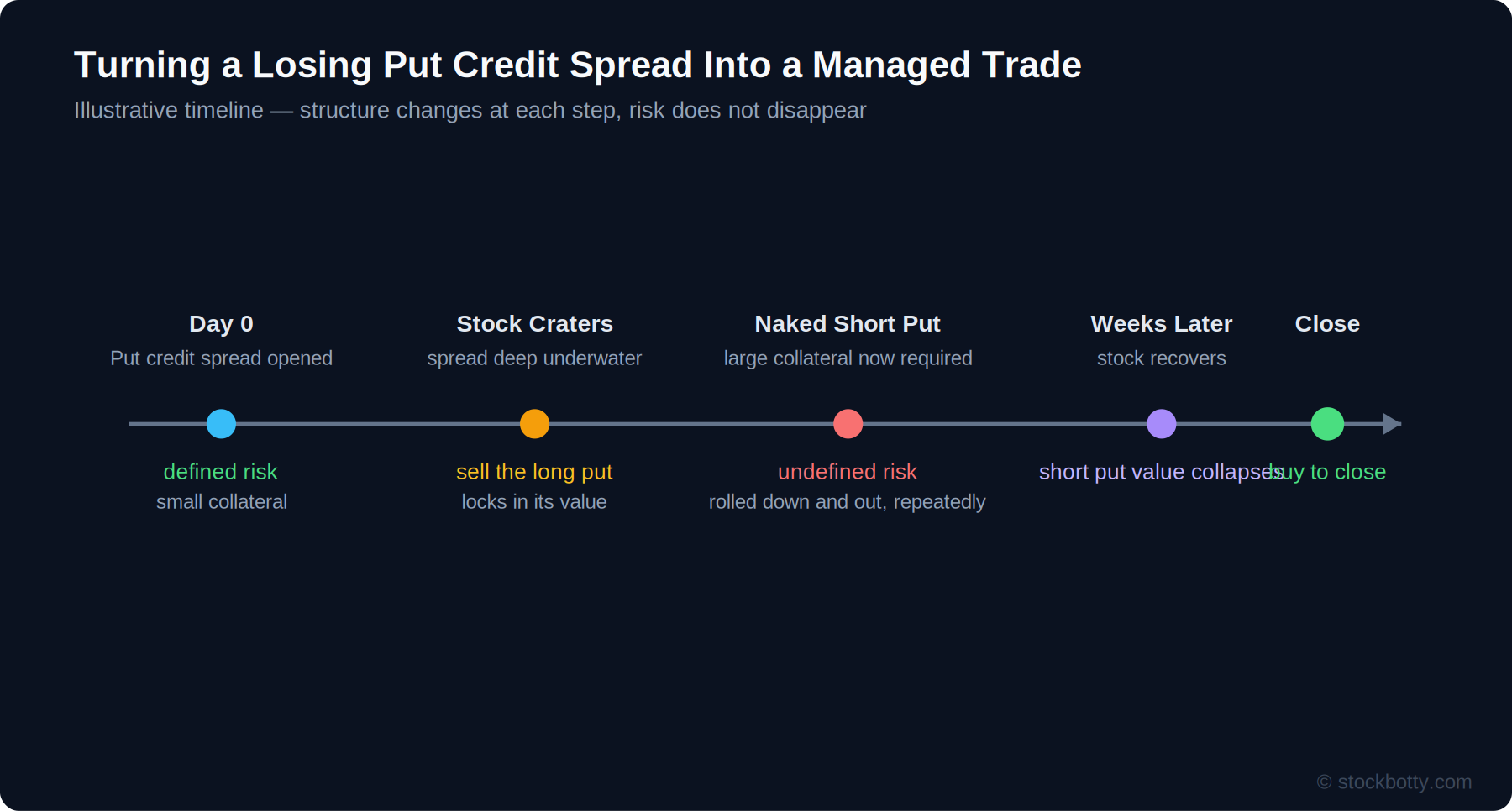
A put credit spread’s whole appeal for me is a small, defined maximum loss. But when a stock drops hard and fast enough, that defined loss can start to feel like a foregone conclusion well before expiration – and when I have the extra capital available, I sometimes intervene rather than simply let the spread run to its max loss. This is one specific way I’ve done that: sell the long put to lock in its value, and manage what’s left – a naked short put – through active rolling until the position either recovers or my plan changes.
My Starting Position
I sell a put credit spread on a stock trading at $110: short the $100 put, long the $97 put, both expiring in 9 days, for a $0.55 credit ($55 collected). Spread width: $3.00 ($300). Max loss: $245.
A sharp, broad market decline hits before expiration, and the stock drops to $85 – well through both my strikes. My spread is now trading close to its maximum loss, with little time left for it to recover on its own.
Step 1: I Sell the Long Put
With the stock at $85, my $97 long put is now deep in the money and worth close to its full intrinsic value. I sell it, converting that value into cash immediately – in this example, for $1,180. What’s left is my $100 short put, now completely uncovered.
This is the pivot point of the whole technique, and I want to be explicit about what just changed for me: my position went from a defined-risk spread, needing $300 of collateral, to a naked short put that needs to be backed the way a cash-secured put would be – roughly $10,000 of collateral at the $100 strike. Without that capital available, this step isn’t something I can do.
Step 2: I Roll the Short Put – Out, Then Down and Out
Same day, I roll my $100 short put to a later expiration at the same strike, for a $65 credit – buying time without changing the strike yet. A few days later, with the stock still under pressure, I roll again: this time both down in strike (to $95) and further out in time, for a $75 debit. Paying a debit to roll down is the cost I accept for meaningfully reducing the odds of the put finishing in the money – a trade-off, not a free adjustment.
Step 3: I Let the Position Work – or I Don’t
Weeks later, the stock recovers strongly, climbing well back above my $95 strike. The short put, which had been worth a large fraction of its strike value at the worst point, is now worth only a small fraction of that. I buy it back for $210, closing the position entirely.
My total result: $55 (initial credit) + $1,180 (sold long put) + $65 (roll credit) − $75 (roll debit) − $210 (buy to close) = $1,015 profit – on a trade that would have settled for a $245 max loss if I’d left it alone.
When This Stops Working
My example above has a happy ending because the stock recovered. That isn’t guaranteed, and it’s the single most important thing I want to be honest about:
- If the stock keeps falling after I sell the long put, my naked short put keeps losing value with no long put underneath to cap it. My loss at that point is no longer bounded by the original spread’s $245 max loss – it scales with how far the stock keeps dropping, the same way any uncovered short put’s risk does for me.
- Rolling down and out doesn’t fix a broken thesis. Each roll buys me time and can reduce the strike, but it doesn’t change what the stock is actually doing. Rolling repeatedly through a genuine, sustained downtrend just extends my exposure and ties up my (much larger) collateral for longer, often while I realize small debits along the way.
- I need a point where my answer is “close it.” Without a predetermined limit – a strike level, a dollar loss, a number of rolls – this technique has no natural stopping point of its own for me. It will keep offering “one more roll” as an option indefinitely, right up until my loss is substantially larger than where the original spread would have capped it.
- This depends entirely on the capital I actually have available. The jump from a few hundred dollars of collateral to backing a full cash-secured put isn’t a small step up for me. Using this technique with capital I need elsewhere, or sizing it larger than the rest of my portfolio can absorb if it goes wrong, would turn a defined-risk trade into a source of real, undefined portfolio risk.
⚠ Risks Beyond the Basics
Beyond the core risk of turning defined risk into undefined risk, a few mechanical details I keep in mind.
Selling the long put has its own execution risk
Deep in-the-money, further-dated puts can have wide bid-ask spreads for me, especially during the kind of sharp, high-volatility decline that triggers this technique in the first place. The credit I actually receive for the long put may be meaningfully less than the theoretical mid-price during fast-moving conditions.
My collateral requirements can change as the stock keeps moving
If the stock continues falling after I’ve established the naked short put, my margin or collateral requirements on that short put can increase, potentially forcing a decision at an inconvenient time rather than on my own schedule.
Multiple rolls compound my transaction costs
Each roll is a closing and opening transaction for me. Several rolls across a recovery period add up in commissions and slippage, which quietly reduces my eventual profit or worsens my eventual loss relative to the theoretical numbers.
This technique is easy for me to rationalize in the moment
Because each individual roll can look like a small, reasonable adjustment, I’ve found it’s possible to end up several rolls deep into a position that has quietly grown far larger and far riskier than the original spread – without any single step feeling like the decision that caused it.
Frequently Asked Questions
What happens when you sell the long put out of a losing put credit spread?
The defined-risk spread becomes a naked short put for me. I lock in the long put’s remaining value as cash, but the position now has undefined downside and I need enough collateral to hold the short put on its own, which is typically far more capital than the original spread required.
Is this technique guaranteed to turn a loss into a profit?
No, and I don’t treat it that way. It only works if the stock recovers enough before the short put’s strike is breached at expiration. If the stock keeps falling, I could end up with a loss far larger than the original spread’s defined maximum loss, since the risk is no longer capped the way it was in the original spread.
Why roll the short put down and out instead of just closing it?
For me, rolling down lowers the strike and reduces the odds of the put finishing in the money, while rolling out buys more time for the stock to recover. Closing outright realizes whatever loss exists at that moment instead of giving the position more room to work.
How much capital does this technique require compared to the original spread?
Substantially more, in my experience. A defined-risk put credit spread only needs collateral equal to the spread width. Once I sell the long put, the remaining short put needs to be backed like a cash-secured put – the strike price times 100 shares per contract – which is often many times what the original spread required.