
A straddle and a strangle are both built from one call and one put in the same expiration – the difference is whether they share a strike or not. A straddle uses the same strike for both. A strangle uses two different strikes, the put below the current price and the call above it. Both come in long and short versions with very different risk profiles, and this guide covers all four variants together, since they’re really one family of strategies with a strike-width dial.
Structure
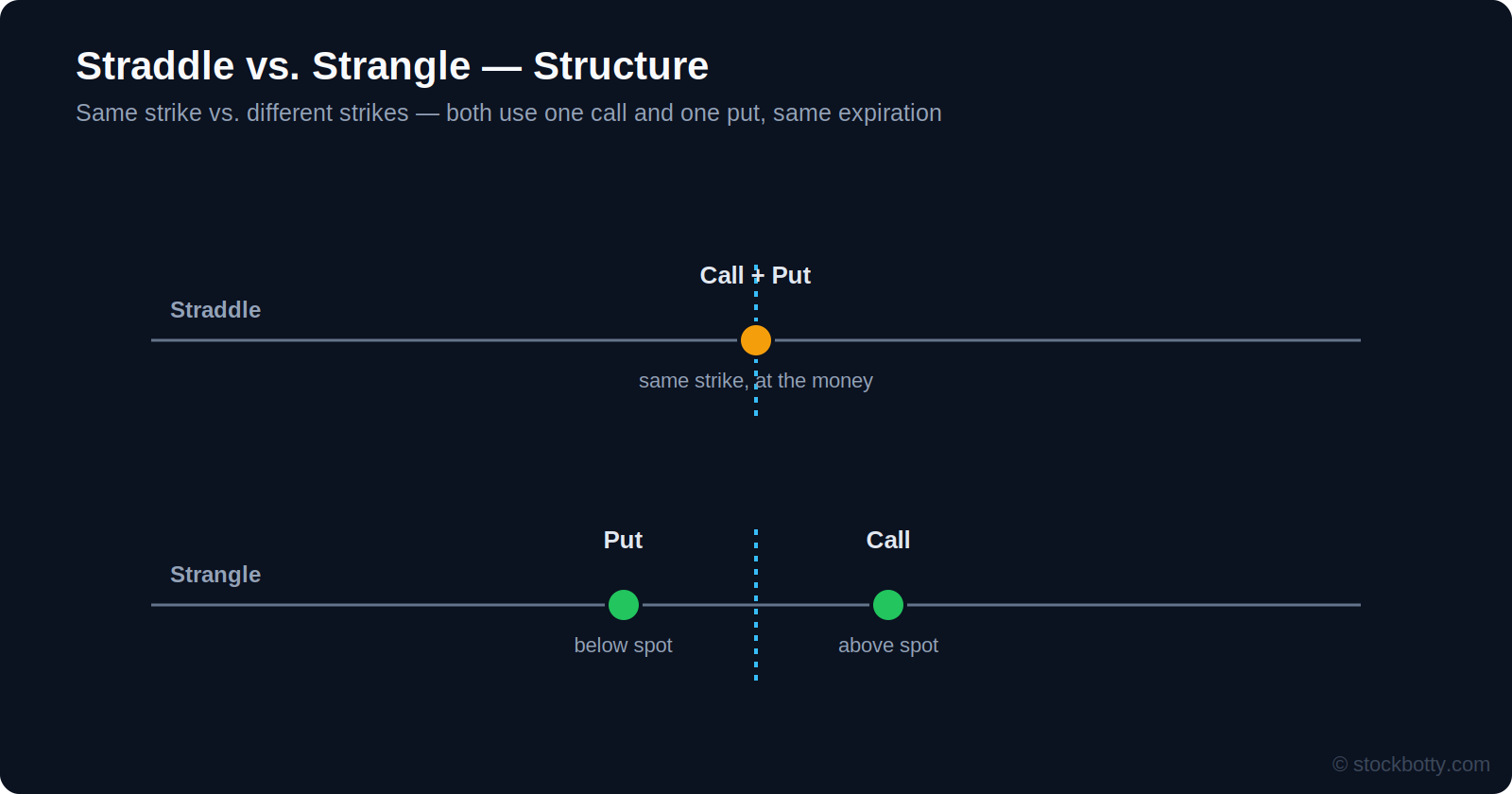
A straddle buys (or sells) 1 call and 1 put at the same strike, typically at or near the current price. A strangle buys (or sells) 1 call above the current price and 1 put below it – the same basic combination, just spread across two strikes instead of one. Because a straddle’s options are both at the money, it’s more expensive to buy (or collects more to sell) than a strangle of similar width.
Long Straddle vs. Long Strangle
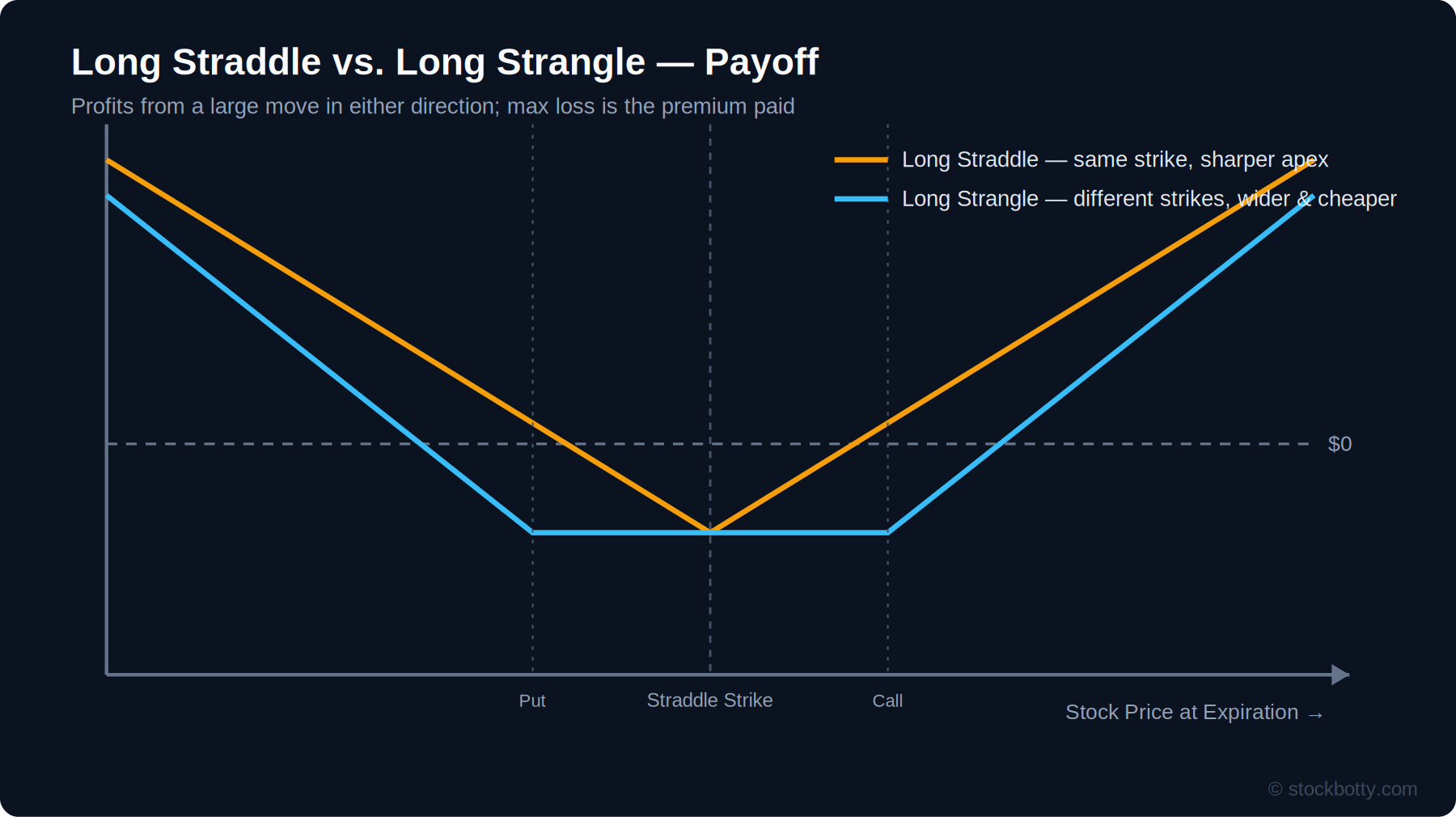
Both long versions profit from a large move in either direction and lose if the stock stays roughly where it is. A long straddle’s V-shape has a sharper point, since both options are struck at the same price – it needs a smaller move to start showing a profit, but costs more to enter. A long strangle’s flatter-bottomed V needs a larger move before either leg gains meaningful value, but it costs less to put on, since both legs start out-of-the-money.
Short Straddle vs. Short Strangle
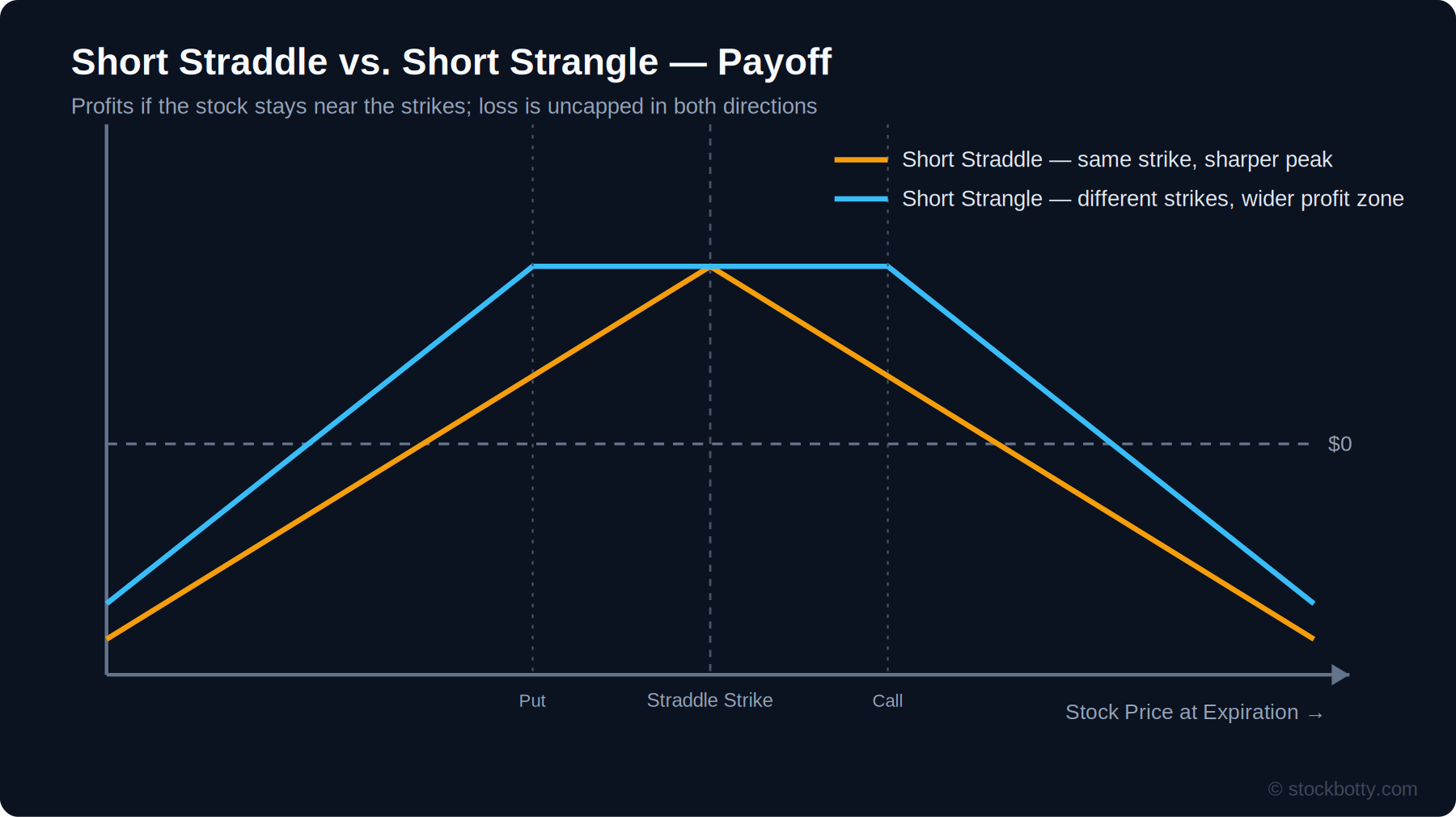
Both short versions profit from the stock staying calm and lose if it moves sharply in either direction. A short straddle’s sharper peak collects more premium but has a narrower range in which that premium is fully kept. A short strangle’s flatter-topped tent collects less premium per leg but keeps its maximum profit across a wider range of prices. Both are uncovered on both sides – there’s no long option capping either the call side or the put side, which is the central risk of the short versions of this strategy.
Choosing Strikes and Expiration
- Strike width (long or short): a straddle’s single strike is usually placed at or very near the current price. A strangle’s two strikes are chosen with a gap between them – wider gaps reduce cost (for long positions) or increase the profitable range (for short positions), at the cost of needing a larger move to become profitable in the long case, or collecting less premium in the short case.
- Days to expiration: long positions bought ahead of a specific catalyst are often sized to just cover that event. Short positions commonly use the 30-45 day range used elsewhere on this site, balancing theta decay against gamma risk near expiration.
- Implied volatility: long straddles and strangles are more attractively priced when IV is low relative to the expected move; short versions are more attractively priced when IV is high, the same principle covered throughout this site’s other strategies.
When to Use Each
- Long straddle or strangle: a specific, known catalyst is approaching (earnings, a ruling, a major announcement) and the direction of the move is genuinely uncertain, but a large move itself seems likely.
- Short straddle or strangle: implied volatility is elevated relative to how much the stock is actually likely to move, and the trader is comfortable with the uncapped risk on both sides in exchange for collecting a large premium.
Managing the Trade
- Long positions are often closed once the anticipated catalyst has passed and implied volatility has collapsed, regardless of whether the move happened – waiting past the event usually means paying ongoing time decay for a thesis that’s already played out.
- Short positions require active management given the uncapped risk on both sides – rolling the untested side closer for additional credit if one side is threatened, or rolling the tested side out in time and further away in strike, follow the same logic covered for other short-premium strategies on this site.
- Tightening a short strangle toward a short straddle – bringing both strikes closer to the current price to collect more premium – is a real technique some traders use, but it increases gamma risk on both sides at once, since both legs then sit nearer the money. A full worked example of this exact adjustment, starting from a losing short put and building up through a strangle into a near-straddle, is covered in the Playbook’s Short Put to Strangle to Straddle entry – including why it’s described there as the single riskiest technique in that series.
Greeks and Volatility Behavior
- Theta: negative for long positions (working against the buyer, the same pattern covered for long calls and long puts on the Greeks page), positive for short positions.
- Vega: positive for long positions – a rise in implied volatility helps both legs at once. Negative for short positions, for the same reason.
- Delta: near zero at entry for both long and short versions when centered at the current price, but shifts as the stock moves toward either strike, since the two legs no longer offset as closely.
- Gamma: highest for the short versions near either strike as expiration approaches – the same gamma risk near expiration covered throughout this site, but present on both the call and put side simultaneously, which is what makes the short versions of this strategy meaningfully riskier than most single-sided short positions.
Example Trade
Long strangle: stock trading at $100 ahead of earnings. Buy the 105-call for $2.50 ($250) and the 95-put for $2.30 ($230), 20 days out. Total cost: $480. Breakevens: roughly $109.80 and $90.20 – the stock needs to move beyond one of those levels to profit.
Short straddle: same stock, no imminent catalyst, IV elevated. Sell the 100-call for $3.20 ($320) and the 100-put for $3.00 ($300), 30-45 days out. Total credit: $620. Max profit: $620, if the stock finishes exactly at $100. Breakevens: roughly $93.80 and $106.20 – losses grow, uncapped on the call side and large on the put side, beyond those levels.
Pros and Cons
Long straddle/strangle pros: profits from a large move in either direction without needing to predict which way, defined and limited maximum loss.
Long straddle/strangle cons: loses value to time decay every day, needs a genuinely large move to overcome the combined premium paid, particularly vulnerable to an IV crush after the anticipated event passes.
Short straddle/strangle pros: collects substantial premium, benefits from time decay, profits across a range of outcomes rather than needing a specific level.
Short straddle/strangle cons: uncapped risk on the call side, very large risk on the put side, requires active management and significant margin.
⚠ Risks Beyond the Basics
A few points worth knowing, especially for the short versions of this strategy.
The short versions combine two of the riskiest exposures covered on this site
A naked short call and a naked short (or cash-secured) put each carry meaningful risk on their own, as covered in the long and short call and long and short put guides. A short straddle or strangle holds both simultaneously, which is why it requires more margin and more active management than either position alone.
IV crush cuts both ways depending on position and timing
A long straddle or strangle bought specifically to capture an IV crush’s opposite – a large price move – can still lose money if implied volatility collapses faster than the stock moves, since the IV component of the premium paid can evaporate quickly right after the anticipated event.
Early assignment risk applies to both legs of the short versions
The same American-style exercise risk covered throughout this site applies independently to the short call and short put in a short straddle or strangle, and since both are uncovered, early assignment on either side creates an unplanned stock position with full market risk attached.
Weekend and overnight gap risk is doubled in direction
Unlike a single-sided short position, a short straddle or strangle is exposed to a large gap in either direction over a weekend or earnings date – there’s no directional side that’s “safe,” since both the call and put sides carry real risk from an unexpected move.
Frequently Asked Questions
What is the difference between a straddle and a strangle?
A straddle buys or sells a call and a put at the same strike. A strangle uses different strikes – the put below the current price, the call above it. A straddle is more expensive (or collects more premium) but has a narrower breakeven range; a strangle is cheaper (or collects less) with a wider range.
When would I use a long straddle or strangle?
When expecting a large move in either direction but uncertain which way – typically ahead of a known catalyst like earnings, where implied volatility hasn’t already fully priced in the expected move.
Is a short straddle or strangle risky?
Yes, significantly. Both are uncovered on both the call and put side, meaning the loss is uncapped (or very large) in either direction if the stock makes a big move past either strike.
Can a short strangle be turned into a short straddle?
Yes, by rolling both strikes closer together toward the same price. This increases the premium collected but also increases gamma risk on both sides, since both legs sit nearer the money.
What is the maximum loss on a short straddle or strangle?
Technically bounded – the put side can’t lose more than the strike price itself, since a stock can’t go below zero – but in practical terms both the call and put sides carry large, effectively uncapped risk if the stock makes a big move.