
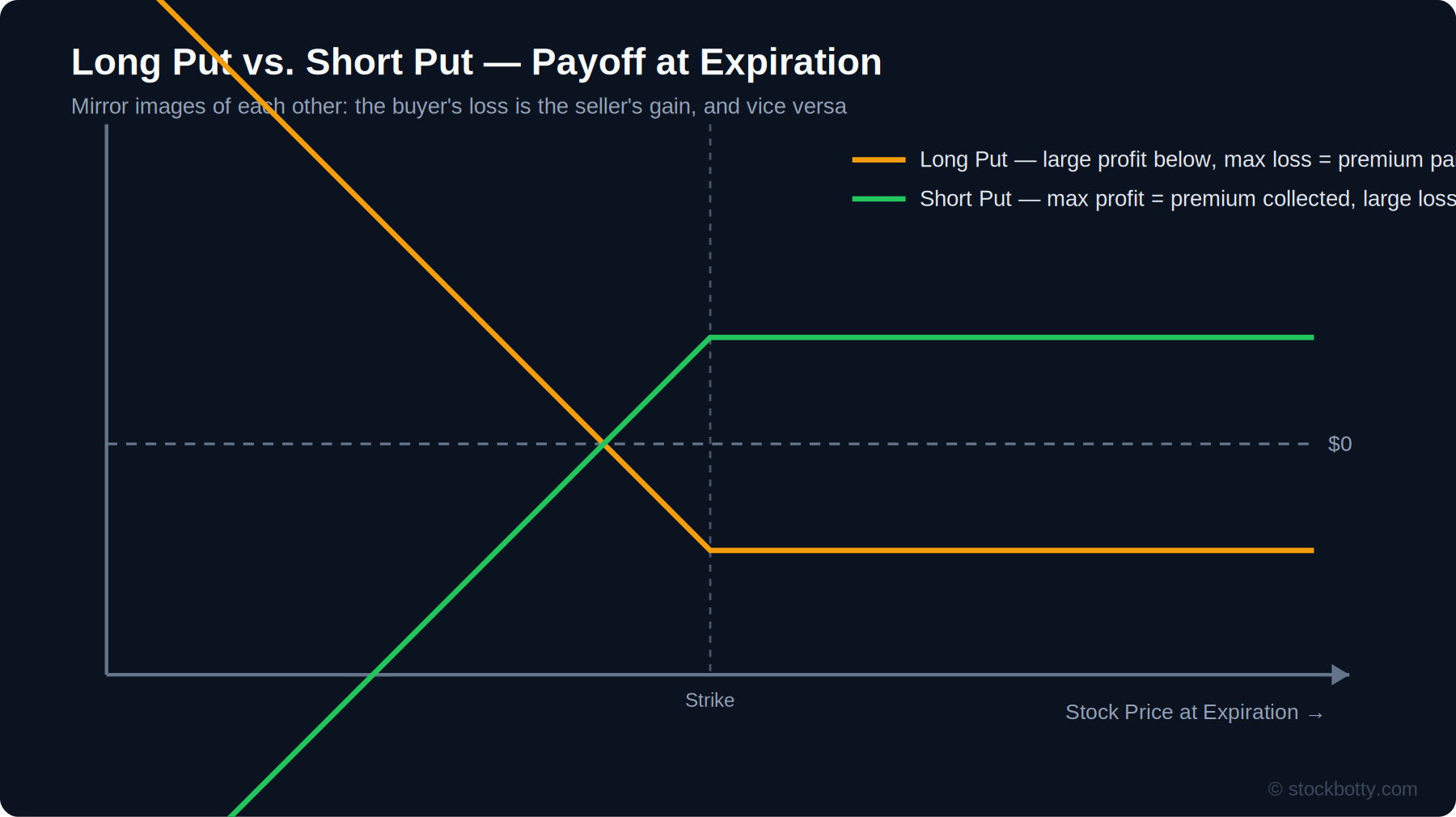
Every put option has two sides: someone buys it, someone sells it. The buyer holds a long put – the right to sell the stock at the strike price, paid for with a premium. The seller holds a short put – the obligation to buy the stock at the strike if assigned, in exchange for collecting that same premium. Like the long and short call, these are the simplest options positions there are, and the building blocks behind every put-based spread covered elsewhere in this series.
A Quick Refresher: Rights vs. Obligations
- Long put (buyer): pays a premium up front for the right, but not the obligation, to sell the stock at the strike price. If the trade doesn’t work out, the buyer simply lets the option expire and loses only what was paid.
- Short put (seller): collects the premium up front and takes on the obligation to buy the stock at the strike if the buyer chooses to exercise. The seller doesn’t get to decide whether the trade continues – the buyer does.
Long Put – Structure
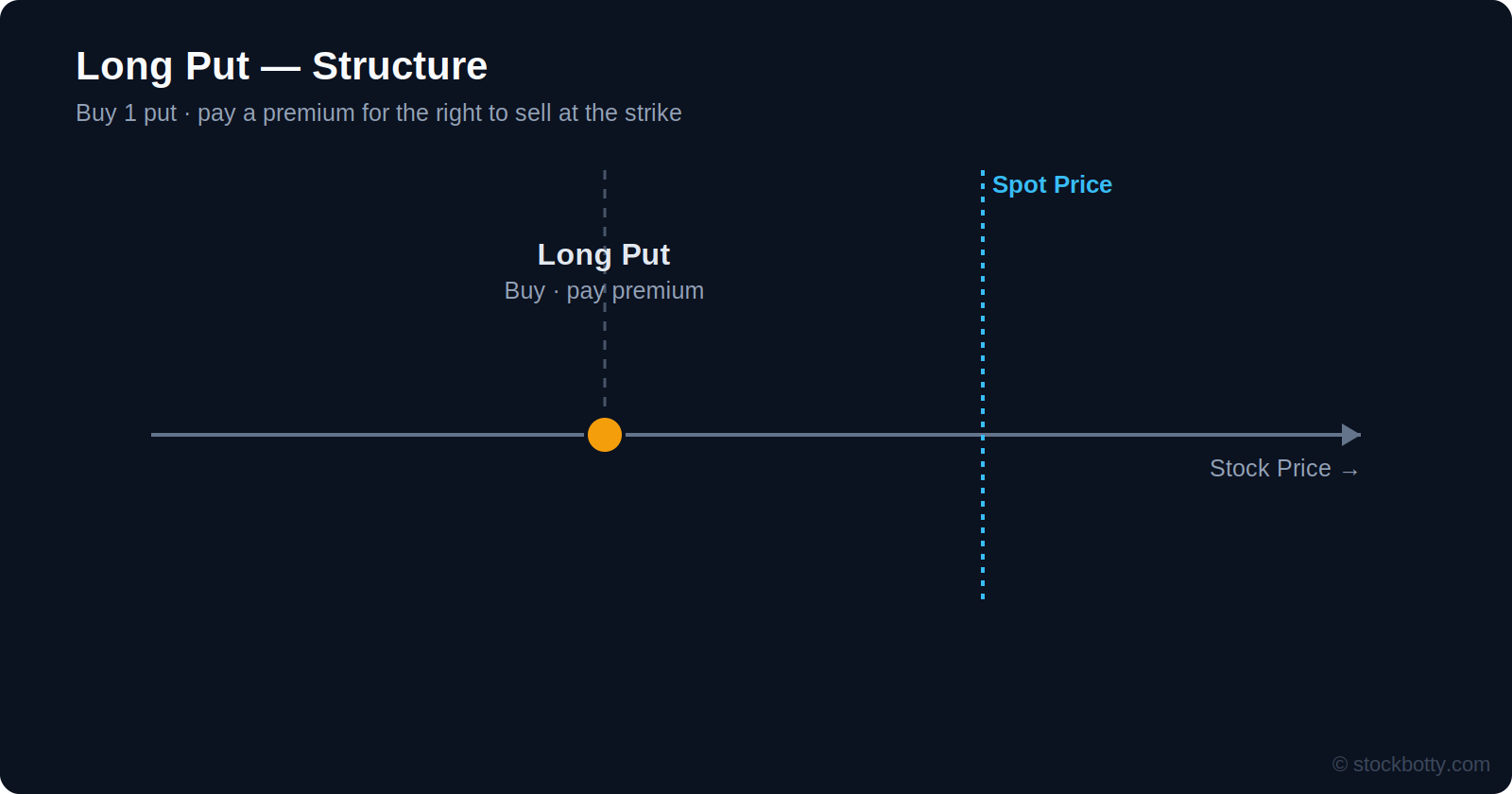
Buy 1 put at a chosen strike and expiration. One contract, one premium paid, nothing else to manage on the position itself.
Short Put – Structure
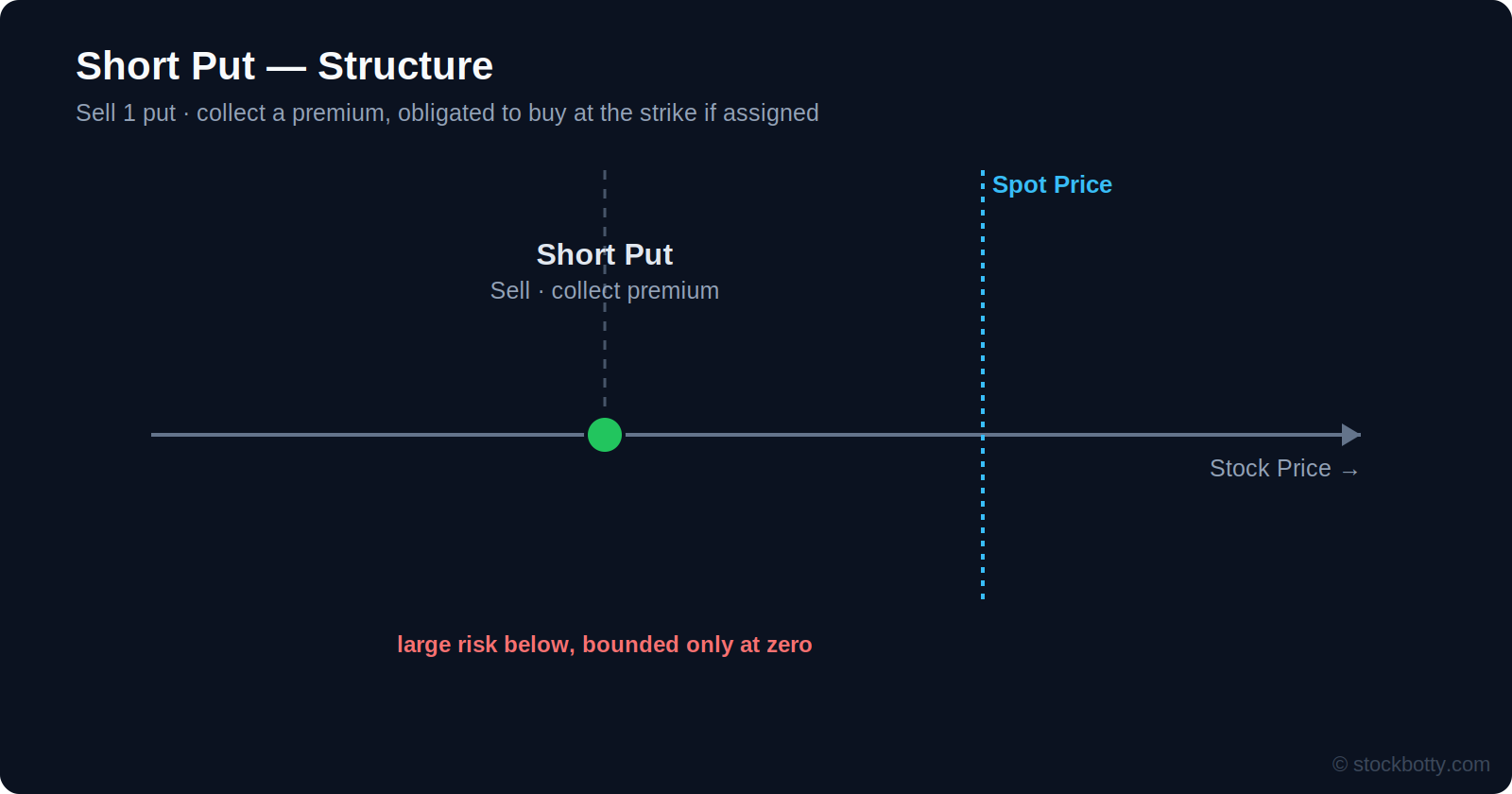
Sell 1 put at a chosen strike and expiration. If cash isn’t reserved to cover assignment, the position is naked and relies on margin – the same role that owning shares plays for a covered call. This guide’s wheel strategy article covers cash-secured puts as part of a full income cycle in more depth.
Payoff at Expiration
The two positions are exact mirror images. Above the strike, the long put is worth nothing and the buyer loses the full premium paid – while the short put keeps the full premium as profit, since it also expires worthless. Below the strike, the relationship flips: the long put’s value rises as the stock falls, dollar for dollar, down to a theoretical zero – while the short put’s losses grow in exactly the same way as the stock keeps falling.
Choosing Strikes and Expiration
- Long put strike selection: a strike near or in the money behaves more like a direct short position on the stock (higher delta, more expensive), while a strike further out of the money is cheaper and more leveraged, but needs a larger move to become profitable.
- Short put strike selection: for a cash-secured put, strikes are typically chosen below the current price at a level the trader is genuinely willing to own the stock, often in a similar 20-30 delta range used elsewhere in this series.
- Days to expiration: buyers generally want more time than they think they need, for the same reason as a long call – time decay accelerates as expiration nears. Sellers often prefer 30-45 days for a similar balance of theta versus gamma.
When to Use a Long Put vs. a Short Put
- Long put: used for a clearly bearish view with defined, limited risk, or as portfolio insurance against a decline in a stock or position already held.
- Short put (cash-secured): used to generate income while waiting to potentially buy a stock at a lower price, effectively getting paid to place a limit order.
- Short put (naked): used by more advanced traders with a bullish-to-neutral view and a plan for managing the large downside risk – generally not a starting point for beginners.
Managing the Trade
- Long put: the same discipline that applies to a long call applies here – a profit target, a time-based exit, and a stop-loss level set in advance, since a put can lose its entire premium simply from running out of time even if the eventual direction is correct.
- Short put (cash-secured): can be rolled down and out if the stock falls and the trader wants to avoid assignment a while longer, or simply allowed to assign into the shares at the strike if that outcome is acceptable.
- Short put (naked): requires active monitoring and a firm risk limit, since the potential loss is large enough to be treated with the same caution as an uncapped position, even though it’s technically bounded at zero.
The Line Lifts – or Sinks – Over Time (T+0)
As with the long call, time decay works against the put buyer. The option’s value today sits above the flat, kinked expiration line near the strike, cushioned by remaining time value – and that cushion shrinks every day, sinking the curve toward the sharp expiration shape rather than lifting it. A stock that goes nowhere doesn’t just fail to help a long put; it actively costs the buyer money.
The short put side is the mirror: the seller’s T+0 line lifts toward the flat, profitable region as time passes, the same pattern described for every selling-side strategy throughout this series. The same premium, the same passage of time, working for one side and against the other.
Greeks and Volatility Behavior
- Theta (time decay): negative for the long put – it loses value every day, all else equal. Positive for the short put – the mirror image.
- Vega (volatility): positive for the long put – a rise in implied volatility increases its value. Negative for the short put.
- Delta (direction): negative for the long put, growing toward -1.00 as it moves deeper in the money. Positive for the short put, in exactly the same magnitude.
- Gamma (acceleration): highest for both positions when the stock is near the strike close to expiration – capable of moving a long put from worthless to valuable quickly, and doing the same to a short put’s losses.
Example Trade
Long put: stock trading at $100. Buy the 95-strike put, 45 days out, for $2.50 ($250 per contract). Max loss: $250, if the stock is above $95 at expiration. Breakeven: $92.50. If the stock falls to $85 at expiration, the put is worth $10.00 ($1,000) – a $750 profit on $250 risked.
Short put (cash-secured): same stock at $100. Sell the 95-strike put for the same $2.50 ($250 collected), reserving $9,500 in cash. If the stock stays above $95, keep the $250. If it’s below $95 at expiration, buy 100 shares at $95 – an effective cost basis of $92.50 after the premium.
Pros and Cons
Long put pros: defined, limited risk, large profit potential as the stock falls, useful as portfolio insurance against an existing position.
Long put cons: loses value to time decay every day, can lose the entire premium even if eventually right about direction but wrong about timing, needs a move large enough to overcome the premium paid.
Short put pros: benefits from time decay, can generate steady income when cash-secured, effectively gets paid to wait for a lower entry price on a stock already wanted.
Short put cons: large downside risk if the stock drops sharply, ties up significant cash (secured) or margin (naked), caps the benefit if the stock only drops a little (premium collected is fixed regardless of how much further it could have fallen).
⚠ Risks Beyond the Basics
Long and short puts look simple, but a few risks are easy to underestimate specifically because the structure looks so basic.
A naked short put’s risk is large, not small, even though it’s “bounded”
Technically the loss is capped once the stock hits zero, but in practice that’s a distinction without much comfort – a sharp decline can produce a loss many multiples of the premium collected, and margin requirements on naked puts increase as the stock falls, which can force a decision at the worst possible time.
Time decay is a real cost, not just an absence of gain
A long put that’s “roughly right” about direction can still lose money if the decline happens too slowly. Every day the stock doesn’t move meaningfully lower, the option is worth measurably less than it was the day before.
IV crush on long puts bought ahead of known events
The same dynamic covered for long calls applies here: buying a put ahead of an anticipated decline often means buying into elevated implied volatility, which can collapse after the event even if the stock does fall – reducing or erasing the expected profit.
Cash-secured doesn’t mean risk-free
Reserving cash to cover assignment protects against a margin call, but it doesn’t protect against the stock declining well below the strike after assignment – the trader still owns a falling stock at that point, just without the additional leverage risk of a naked position.
Weekend and overnight gap risk on naked short puts
A large overnight gap down on unexpected news is the most dangerous scenario for a naked short put – there’s no opportunity to adjust intraday, and the loss can be severe before the market opens for a reaction.
Frequently Asked Questions
What’s the difference between a long put and a short put?
A long put buys the right to sell the stock at the strike price, paying a premium up front. A short put sells that right to someone else, collecting the premium but taking on the obligation to buy the stock at the strike if assigned. They are mirror images of the same contract.
What is the maximum loss on a long put?
The premium paid to buy it. That’s the most a long put can ever lose, regardless of how far the stock rises.
What is the maximum risk on a short put?
The stock falling to zero, minus the premium collected, multiplied by 100 shares per contract. This is technically bounded, unlike a naked short call, but large enough in practice to be treated with the same caution.
Is a short put the same as a cash-secured put?
A cash-secured put is a short put where the trader sets aside enough cash to buy the shares if assigned. A short put without that reserved cash is a naked put, which uses margin instead and can be forced into a larger, less controlled position if the stock drops sharply.
How does time decay affect a long put?
Negatively. A long put loses value from time decay every day, all else equal, since it’s a wasting asset that must overcome that decay with a large enough downward move in the stock to be profitable.
When does a short put make sense?
As a cash-secured put on a stock the trader is willing to own at the strike price, to collect income while waiting for a lower entry, or as a bullish-to-neutral bet by more advanced traders comfortable managing the large downside risk of a naked position.