
LEAPS – Long-term Equity AnticiPation Securities – are simply options with a long time to expiration, typically anywhere from 9 months to about 3 years out. Nothing about how they’re priced is different from a standard option; what changes is how much time value they carry and how slowly that value decays early in their life. Once that’s understood, the Poor Man’s Covered Call (PMCC) follows naturally: it’s a covered call built with a LEAP standing in for the 100 shares, for a fraction of the capital.
What Makes LEAPS Different
A LEAP is priced with the same model as any other option – it’s the amount of time remaining that changes its character. With 12 or more months to expiration:
- Theta decay is slow early on. The theta curves explained on the Greeks page apply here directly – an option far from expiration sits on the flat, early part of its decay curve, long before the acceleration that happens in the final weeks.
- Delta moves more like the stock for options bought deep in the money, since a large share of the option’s value is already intrinsic.
- Leverage is meaningful: a LEAP with a delta around 0.70 gives roughly 70% of the stock’s dollar-for-dollar price exposure for a fraction of the capital required to own the shares outright.
Capital Efficiency: LEAPS as a Stock Substitute
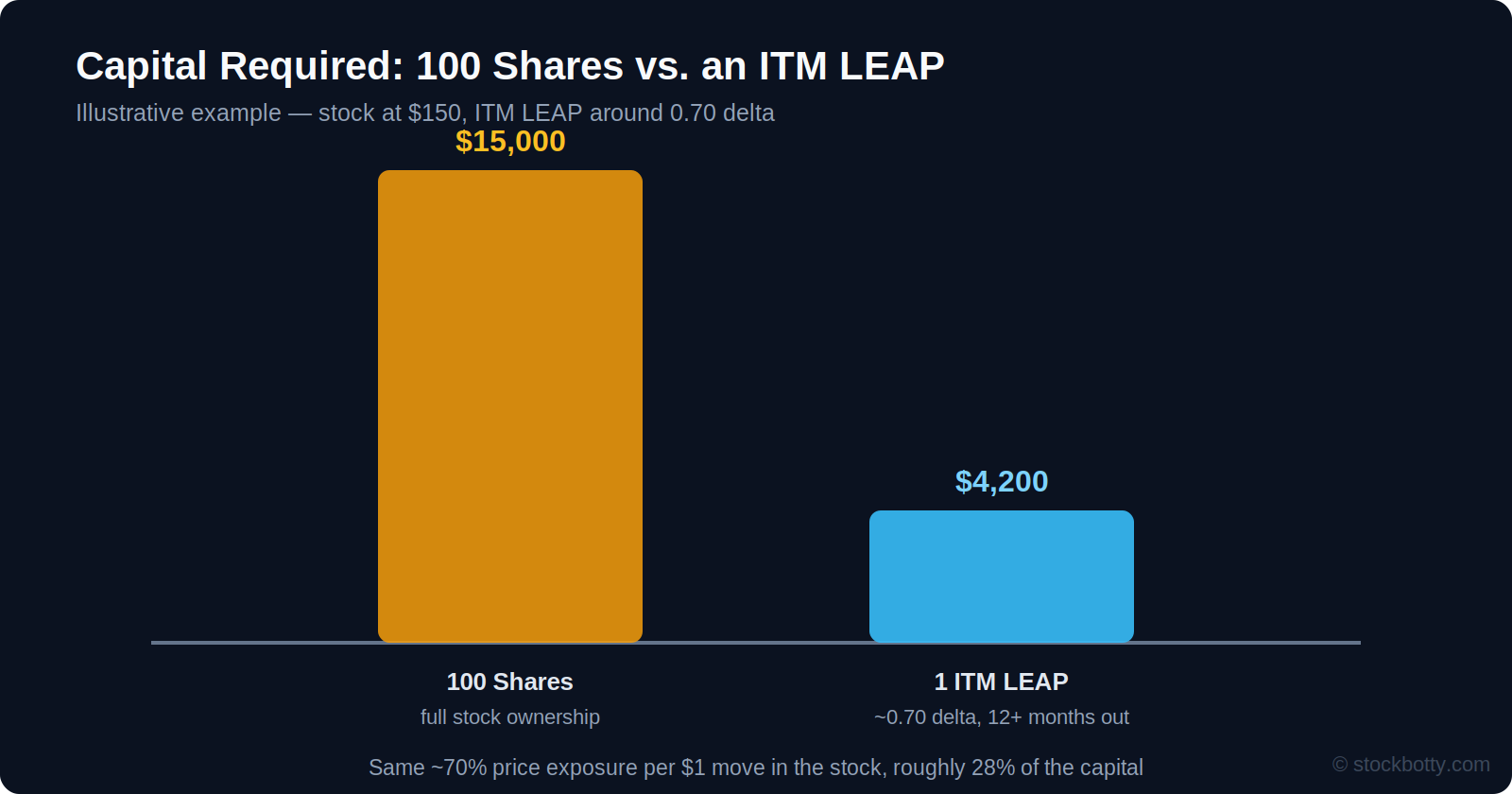
Stock trading at $150. Buying 100 shares outright costs $15,000. An in-the-money LEAP around a 0.70 delta, 12-18 months out, might cost roughly $4,200 – around 28% of the capital, for close to 70% of the price exposure per dollar the stock moves. The freed-up capital can sit as a buffer, fund other positions, or simply reduce how much is tied up in a single name.
Choosing the Right LEAP
- Delta range: a common target is 0.65-0.80 – deep enough in the money that the option behaves close to the stock and holds a high proportion of intrinsic value, without paying for a delta of 1.00 that erases the capital advantage entirely.
- Implied volatility: entering when IV-Rank is low matters here just as much as for any other long option position – see the IV-Rank section on the strategies overview for why buying into elevated IV adds a volatility-contraction risk on top of the directional bet.
- Time horizon: LEAPS are a position built around a stock’s longer-term trend, generally held over a 6-18 month view rather than managed for a near-term catalyst.
What Is a Poor Man’s Covered Call?
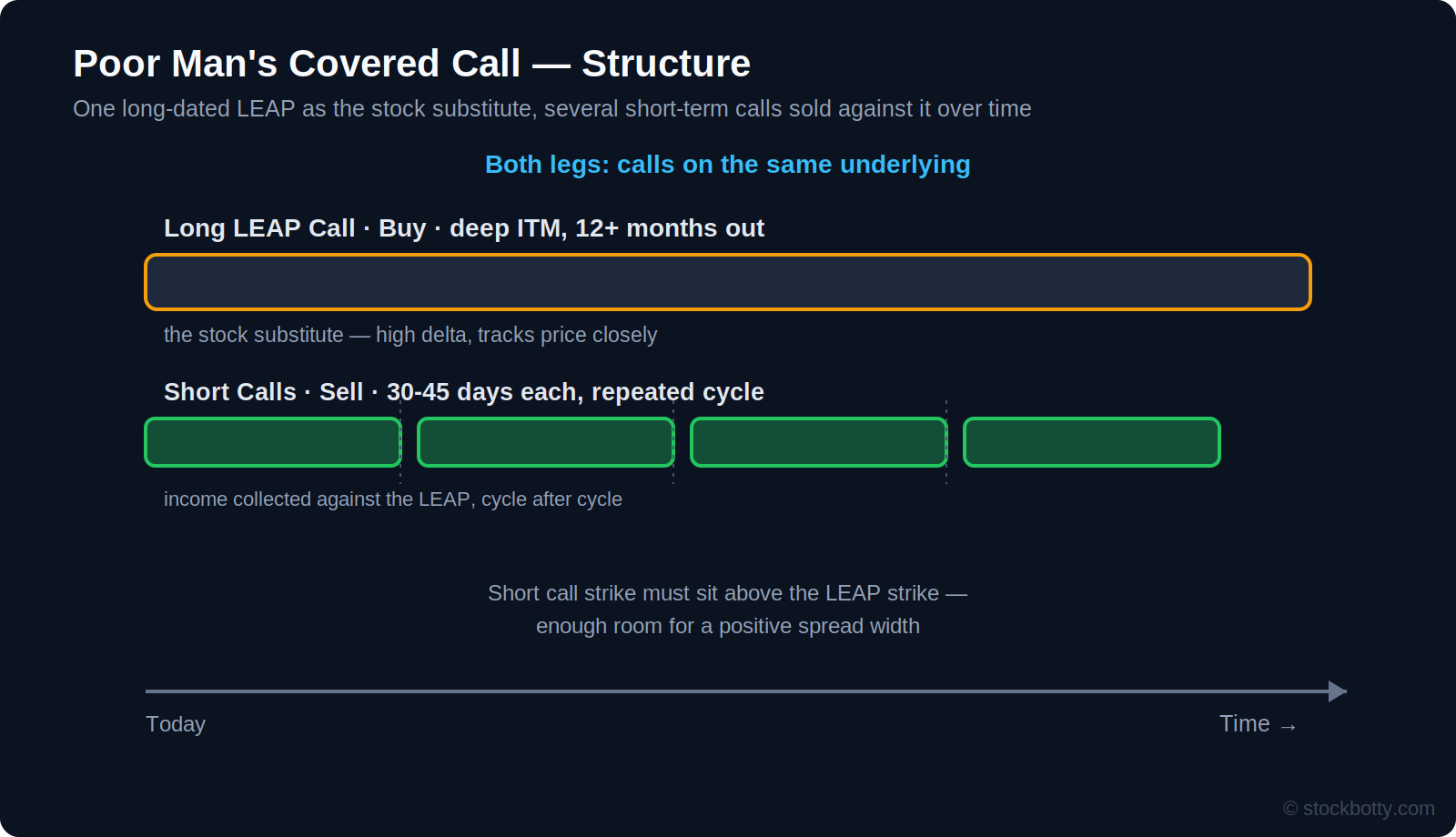
A PMCC buys one deep in-the-money LEAP as the stock substitute, then sells shorter-dated, out-of-the-money calls against it – typically 30-45 days out, often in the same 20-30 delta range used for short calls elsewhere on this site – collecting premium cycle after cycle the same way a covered call seller would against real shares. Structurally, it’s a diagonal call spread: two different strikes, two different expirations, both calls.
The short call’s strike has to sit above the LEAP’s strike with enough room to leave a positive spread width – selling a call at or below the LEAP’s own strike doesn’t make sense in the same way selling a covered call below your cost basis on real shares can, since it can leave no room for profit even in the best case.
Where a PMCC Is Not the Same as a Real Covered Call
The name is a fair description, but the mechanics diverge in ways worth being precise about:
- Delta isn’t 1.00. Real shares always move dollar-for-dollar with the stock. A 0.70 delta LEAP doesn’t – it’s a close approximation, not an identical hedge, and that gap widens on very large or very fast moves.
- The LEAP can lose most or all of its value. A sustained decline in the stock can push the LEAP toward worthless before expiration in a way real stock ownership simply doesn’t experience – shares retain their market value minus the decline; a LEAP’s value is also affected by shrinking time value and can fall faster than the stock itself in percentage terms.
- Assignment on the short call doesn’t work the same way. If the short call is assigned, there are no real shares sitting in the account to deliver. In practice, this is managed by closing both legs or rolling the short call before assignment becomes likely, not by exercising the LEAP to produce shares on the spot.
Greeks in a PMCC – Including a Common Misconception
- Delta: the LEAP’s delta (around 0.65-0.80) is partially offset by the short call’s smaller negative delta, leaving the position net long but with less than 1.00 delta exposure per contract.
- Theta: generally net positive for the position as a whole – the short-term call decays faster than the long LEAP loses value, which is the same mechanism that makes a calendar spread work.
- Vega: this is where the position is often mischaracterized. A deep in-the-money LEAP does have lower vega than an at-the-money option of the same expiration – but vega also scales with time to expiration, and a LEAP has a lot of time left. In absolute dollar terms, a 12-18 month LEAP frequently carries more vega than a 30-45 day option, simply because there’s so much more time value at risk. “Less sensitive to volatility” is only true when comparing the LEAP to an at-the-money option at the same expiration – it is not true when comparing it to a short-dated option. A broad IV contraction can still meaningfully affect a PMCC’s long leg.
Managing a PMCC
- Rolling the short call cycle after cycle is the core management routine, the same discipline used for any covered call – closing or rolling before the short strike is seriously threatened, and opening the next cycle’s call afterward.
- If the stock rallies hard through the short strike, upside is capped there for that cycle. Rolling the short call up and out, or simply letting that cycle close and reassessing the LEAP’s position, are the usual responses – exercising the LEAP to “deliver” shares is rarely the practical choice.
- If the stock declines meaningfully, the LEAP’s delta and value both fall, and the short call’s premium alone is unlikely to offset that decline the way it might for a smaller pullback. This is the scenario where the difference from real stock ownership matters most – there’s no floor here the way there conceptually is with shares you simply continue to hold.
⚠ Risks Beyond the Basics
The capital efficiency of a PMCC is real, but it comes with mechanics that are easy to gloss over when the strategy is framed as “a cheaper covered call.”
The hedge is approximate, not exact
Because the LEAP’s delta is below 1.00, the position doesn’t respond to the stock exactly the way owning shares would – the gap between “close approximation” and “exact hedge” tends to widen precisely during the large, fast moves where it would matter most.
Vega risk is understated by the “mostly intrinsic value” framing
As covered above, a LEAP’s long time to expiration means it can carry substantial dollar vega despite being deep in the money. A broad volatility contraction – the kind that helps most short-premium strategies – can work against the long leg of a PMCC more than the “low vega” reputation suggests.
The LEAP has a real risk of substantial loss that shares don’t share
A large, sustained decline in the stock can erode a LEAP’s value faster than the stock itself falls, and – unlike shares, which can simply be held indefinitely – the LEAP will eventually expire. There is no “wait it out forever” option once time runs out.
Liquidity on far-dated, deep ITM strikes can be thin
LEAPS, especially well in the money, often trade with wider bid-ask spreads than near-term options on the same stock. This affects both the entry price and how efficiently the position can be adjusted or closed later.
Assignment on the short call requires active management
Without real shares behind the position, an assigned short call has to be handled by closing or rolling before or at assignment, not resolved passively the way a real covered call’s assignment can be. Traders who treat a PMCC as fully passive can be caught needing to act quickly.
Frequently Asked Questions
What does LEAPS stand for?
Long-term Equity AnticiPation Securities – options with expirations typically beyond 9 months, up to about 3 years out. They behave like standard options but with far more time value and a slower rate of theta decay in their early life.
What is a Poor Man’s Covered Call (PMCC)?
A diagonal call spread: buying a long-dated, deep in-the-money LEAP call as a stock substitute, then selling short-term calls against it repeatedly, similar in spirit to a covered call but requiring a fraction of the capital that owning 100 actual shares would.
Is a PMCC the same as a real covered call?
Not exactly. A real covered call is backed by 100 actual shares with a delta of 1.00. A PMCC’s LEAP typically has a delta below 1.00, so it doesn’t move dollar-for-dollar with the stock the way real shares do, and the LEAP itself can lose most or all of its value if the stock falls far enough before expiration – something real stock ownership doesn’t do the same way.
Are LEAPS less sensitive to implied volatility than short-dated options?
Only relative to an at-the-money option of the same expiration. In absolute dollar terms, a LEAP often carries more vega than a short-dated option, simply because it has so much more time value at risk. Being deep in the money reduces vega somewhat, but it doesn’t make a LEAP immune to implied volatility moves.
What delta is typically used for a PMCC’s LEAP?
A common range is roughly 0.65 to 0.80 delta – high enough to track the stock’s price movement closely and keep the position weighted toward intrinsic value, while still costing meaningfully less than owning the shares outright.