
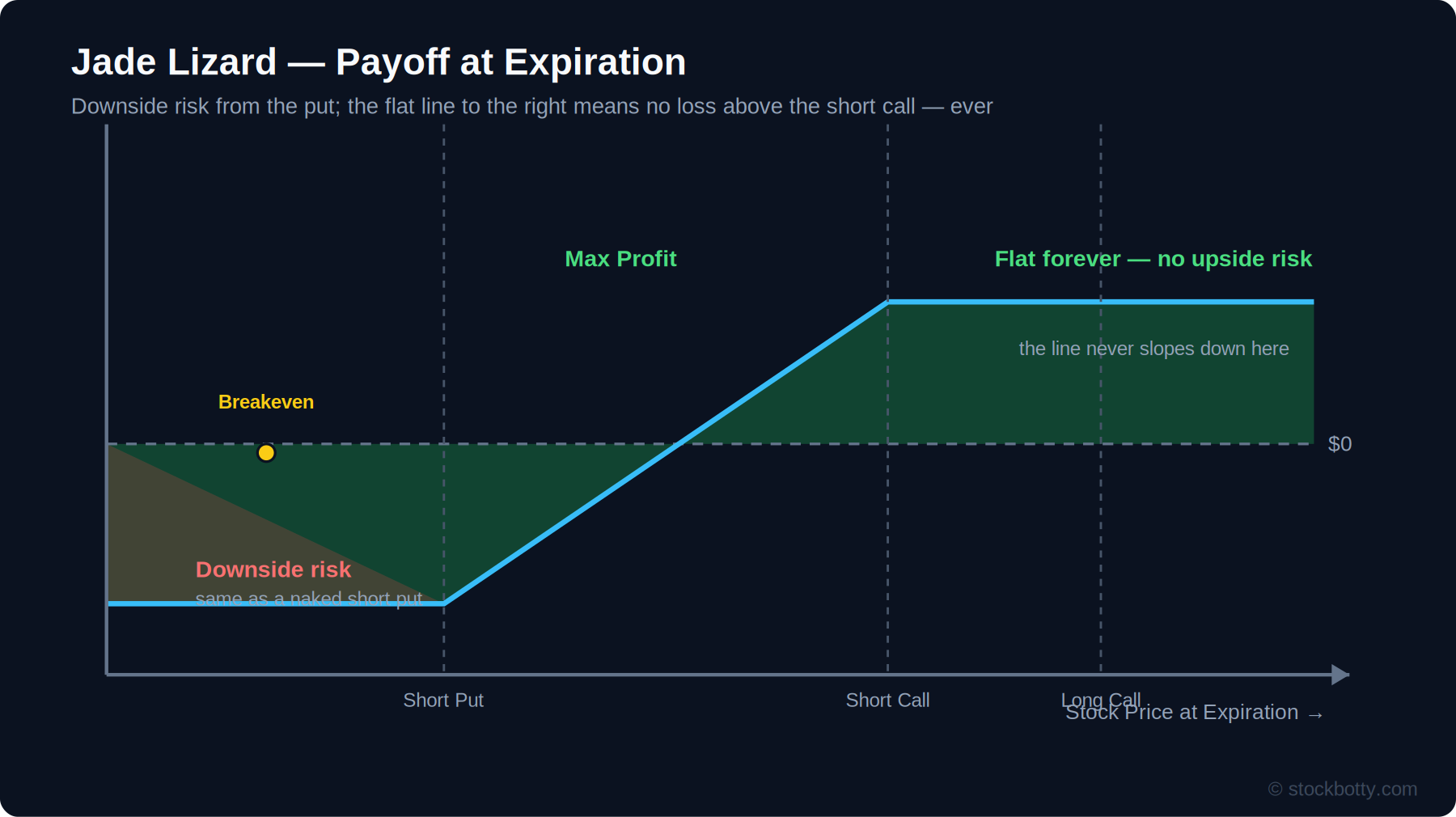
A jade lizard combines a short put with a call credit spread, all in the same expiration – three legs built with one specific design goal: if sized correctly, the position has no risk at all above the short call strike, no matter how far the stock rallies. That’s the strategy’s defining feature, and it’s worth understanding exactly why it works, since it depends entirely on how the position is constructed, not on anything inherent to the three legs individually.
Structure
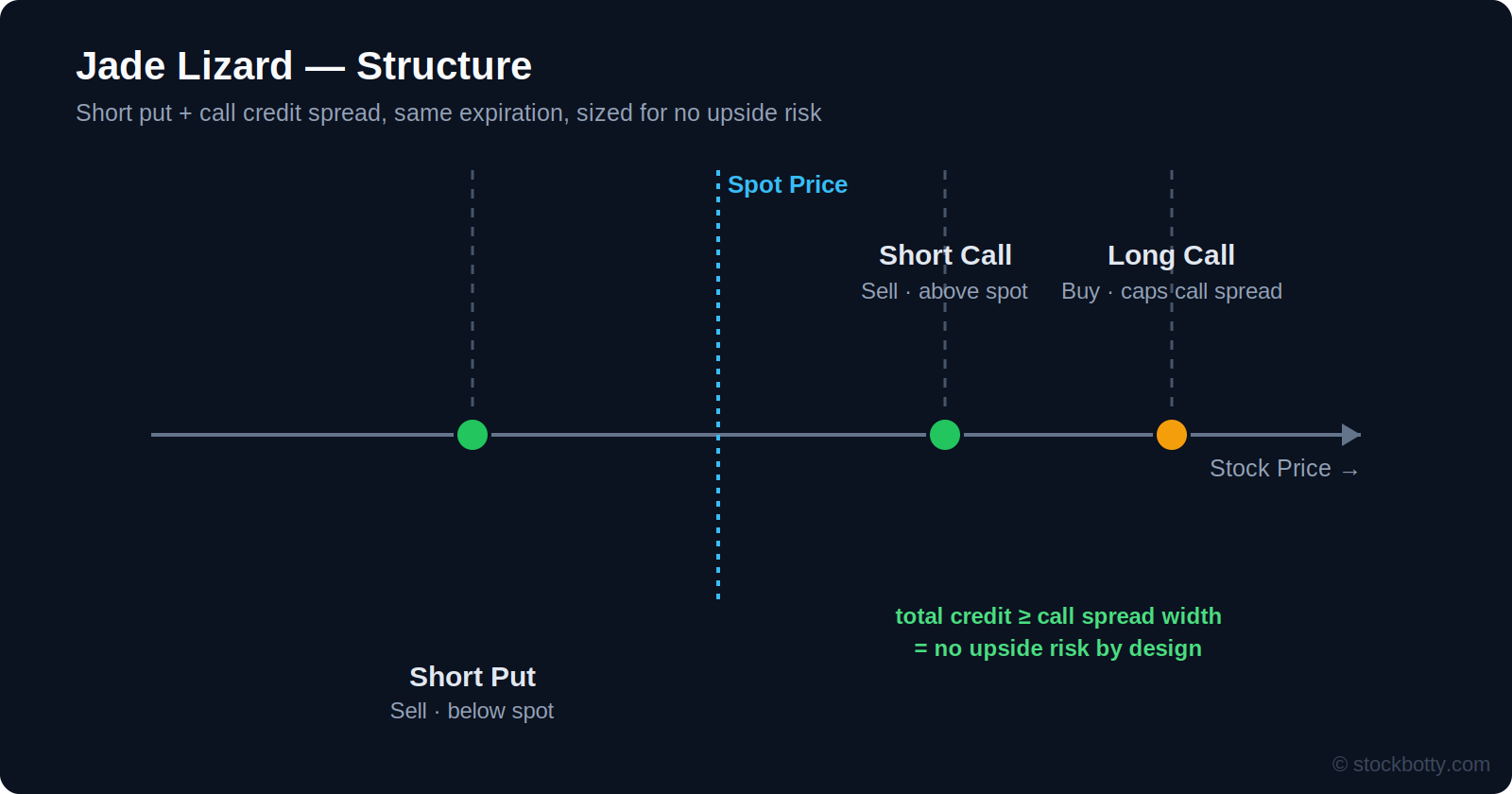
Sell 1 put below the current price. Sell 1 call above the current price, and buy 1 further call above that as protection – a standard call credit spread. All three legs share the same expiration. The put is typically not covered by a matching long put, so its risk profile is the same as a standalone short put.
The Design Principle: No Upside Risk, By Construction
This only works if the strikes and premiums are chosen so that the total net credit collected is greater than or equal to the width of the call spread. The call spread’s maximum possible loss is fixed – the distance between its two strikes, minus whatever credit was collected specifically from that spread. If the total credit collected across all three legs covers that maximum loss entirely, there’s nothing left to lose on the call side even if the stock rallies without any limit. The put’s premium is effectively doing double duty: it pays for taking on put-side risk, and it also finances the call spread’s protection.
Payoff at Expiration
Below the short put strike, the position behaves exactly like a standalone short put – losses grow as the stock falls, the same large, technically-bounded-at-zero risk covered in the long and short put guide. Between the short put and the short call, the position sits at its maximum profit – the full net credit collected. Above the short call, in a normal call credit spread the payoff would decline toward a defined maximum loss. In a properly sized jade lizard, it doesn’t: the line stays flat, because the credit already collected fully offsets whatever the call spread could lose.
Choosing Strikes and Expiration
- Call spread width: narrower spreads are easier to fully offset with credit but collect less total premium; wider spreads collect more but require a richer put premium to still clear the “credit ≥ width” bar.
- Short put strike: placed using a similar delta-based approach to other short puts on this site, balancing meaningful premium against the odds of being tested.
- Days to expiration: 30-45 days is common, the same range used for other premium-selling strategies covered on this site.
- Elevated implied volatility makes the “credit ≥ width” condition easier to satisfy, since richer premium on all three legs makes it more likely the total credit clears the call spread’s width.
When to Use a Jade Lizard
- A neutral-to-mildly-bullish view – comfortable with the stock staying flat or rising, without needing to predict how far it might rise.
- A preference for one-sided risk – accepting real downside exposure from the put in exchange for genuinely removing upside risk, rather than just capping it the way an iron condor’s call side does.
- Elevated IV, the same condition that favors most premium-selling strategies on this site, since it makes collecting enough credit to satisfy the design principle easier.
Managing the Trade
- The put side is managed the same way as any short put – the premium-multiple framework covered in the Playbook’s short put adjustment guide applies directly to the put leg of a jade lizard.
- The call spread side rarely needs active management if the position was correctly sized, since there’s no loss to defend against on that side by design.
- Taking profits early once a large share of the credit has decayed follows the same logic used throughout the premium-selling strategies on this site.
Greeks and Volatility Behavior
- Theta: positive – all three legs are short-option-dominated in terms of time decay working in the position’s favor, similar to an iron condor.
- Vega: negative overall, since the position is net short premium, though the exact magnitude depends on how the three legs’ individual vegas net out.
- Delta: modestly positive at entry, reflecting the mildly bullish bias from having more short premium on the put side than the call side nets out to.
- Gamma: concentrated near the short put strike as expiration approaches, the same gamma risk near expiration covered throughout this site – the call side carries comparatively little gamma risk once the position is safely past the short call strike, since there’s no loss to accelerate into on that side.
Example Trade
Stock trading at $100. Sell the 92-strike put for $2.80 ($280). Sell the 108-strike call for $2.20 ($220) and buy the 112-strike call for $0.70 ($70) – a $4 wide call spread for a $1.50 net credit ($150). Total credit collected: $280 + $150 = $430.
- Call spread width: $400. Total credit collected ($430) exceeds that width by $30 – the no-upside-risk condition is satisfied with a small cushion.
- Above $108, however high the stock goes: no loss on the position. The call spread’s maximum loss ($400 − $150 = $250) is more than covered by the $280 put premium alone.
- Between $92 and $108: maximum profit, the full $430 credit collected.
- Below $92: losses grow the same way they would for a standalone short put at that strike, offset only by the $430 total credit.
Pros and Cons
Pros: genuinely no risk above the short call strike when properly constructed, benefits from time decay, collects premium from three legs at once, doesn’t require guessing how far a rally might go.
Cons: downside risk is real and undefined in practice, the same as a standalone short put; achieving the “credit ≥ width” condition isn’t guaranteed and depends on market pricing at the time; three-leg execution is more complex than a simple short put or vertical spread.
⚠ Risks Beyond the Basics
The “no upside risk” feature is genuinely correct when the position is built properly – but it’s easy to overstate what that actually covers.
No upside risk doesn’t mean no risk
The defining feature only applies above the short call strike. The put side carries the same large, practically uncapped risk as any standalone short put, and it’s usually the larger risk in the entire structure. A jade lizard removes one specific risk, it doesn’t create a risk-free trade.
The “credit ≥ width” condition isn’t automatic
Whether a given set of strikes actually satisfies the no-upside-risk design depends on real-time option pricing. In lower-IV environments, achieving this condition can require strikes closer to the money than intended, changing the risk profile the trader actually ends up with.
Early assignment and dividend risk apply to both short legs
The same American-style exercise risk covered throughout this site applies to the short put and the short call independently, particularly around ex-dividend dates on the call side.
Three-leg execution adds slippage risk
Filling three separate contracts as a single order is standard, but on less liquid underlyings the combined bid-ask spread across all three legs can meaningfully affect whether the credit actually collected clears the width the strategy depends on.
Frequently Asked Questions
What is a jade lizard?
A three-leg options strategy combining a short put with a call credit spread, all in the same expiration. It’s specifically sized so the total credit received is at least as large as the call spread’s width, which removes any risk above the short call strike.
Why does a jade lizard have no upside risk?
Because the net credit collected is set to be greater than or equal to the maximum possible loss on the call credit spread. Even if the stock rallies without limit, the capped loss on the call spread is fully offset by the credit already collected, so there’s nothing left to lose on that side.
Does a jade lizard have any risk at all?
Yes, on the downside. The short put carries the same large, technically-bounded-at-zero risk any short put does if the stock falls sharply. The “no risk” feature only applies above the short call strike, not below the short put strike.
What happens if the credit doesn’t cover the call spread width?
Then it isn’t a true jade lizard in the strict sense – it’s simply a short put plus a call credit spread with defined risk on both sides, similar in character to an iron condor’s call side. The no-upside-risk feature specifically depends on the credit meeting or exceeding the spread width.
Is a jade lizard bullish or bearish?
Neutral to mildly bullish. It profits if the stock stays above the short put strike, and doesn’t lose from any amount of upside, but the short put means it isn’t a bearish position – a sharp decline still produces a loss.