
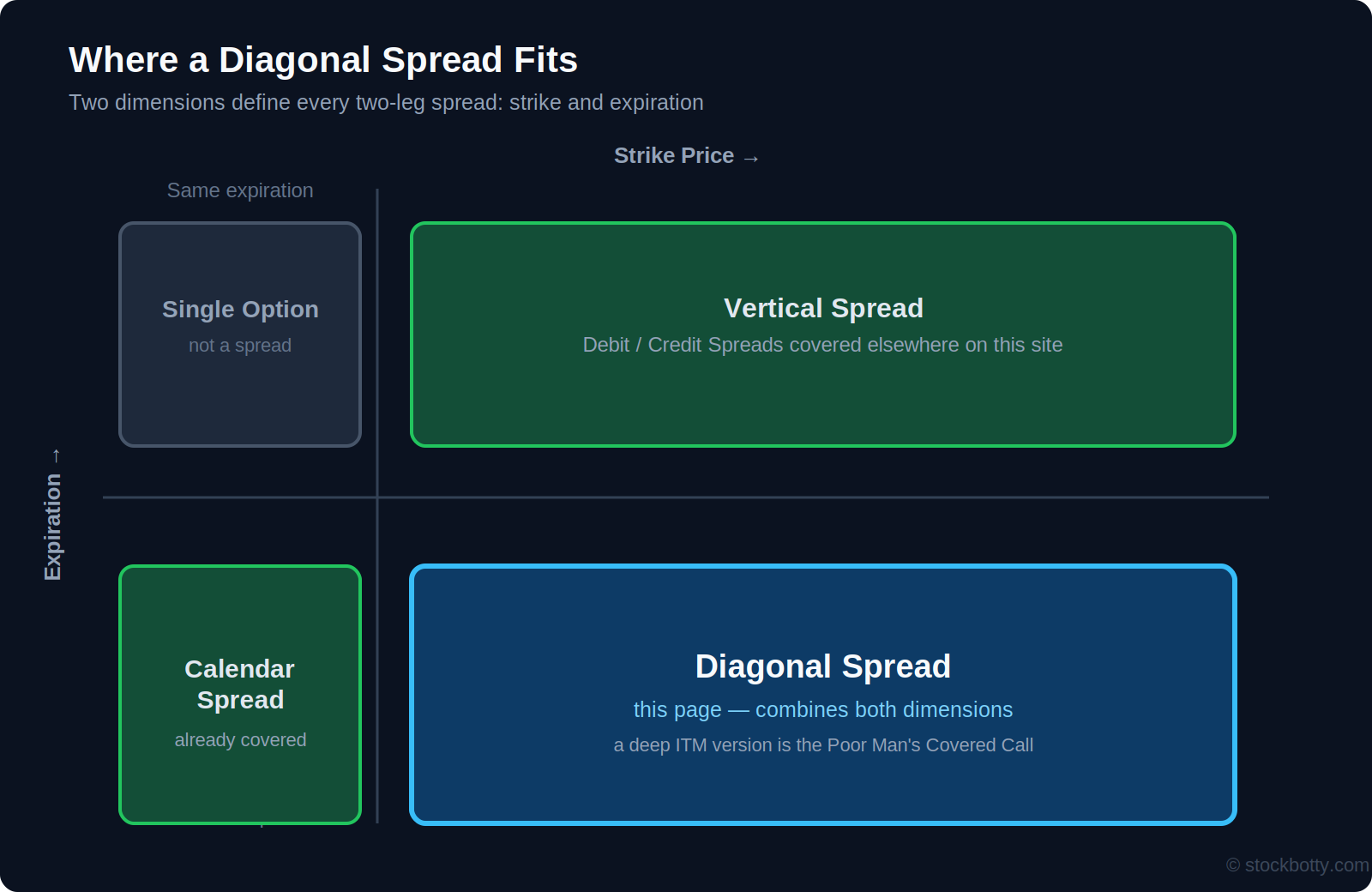
A diagonal spread sits at the intersection of two ideas already covered on this site. A calendar spread uses the same strike across two different expirations. A vertical spread (covered in the call and put debit and credit spread guides) uses different strikes within the same expiration. A diagonal spread combines both: different strikes and different expirations. This guide covers how that combination works, and how it relates to two strategies already covered elsewhere on this site.
Where a Diagonal Spread Fits
Every two-leg spread built from the same option type can be placed on two dimensions: whether the strikes match, and whether the expirations match. Same strike, same expiration isn’t a spread at all – it’s just one option. Same strike, different expiration is a calendar spread. Different strikes, same expiration is a vertical spread. Different strikes and different expirations is a diagonal spread – and, in one specific extreme form, the Poor Man’s Covered Call already covered on this site.
Structure
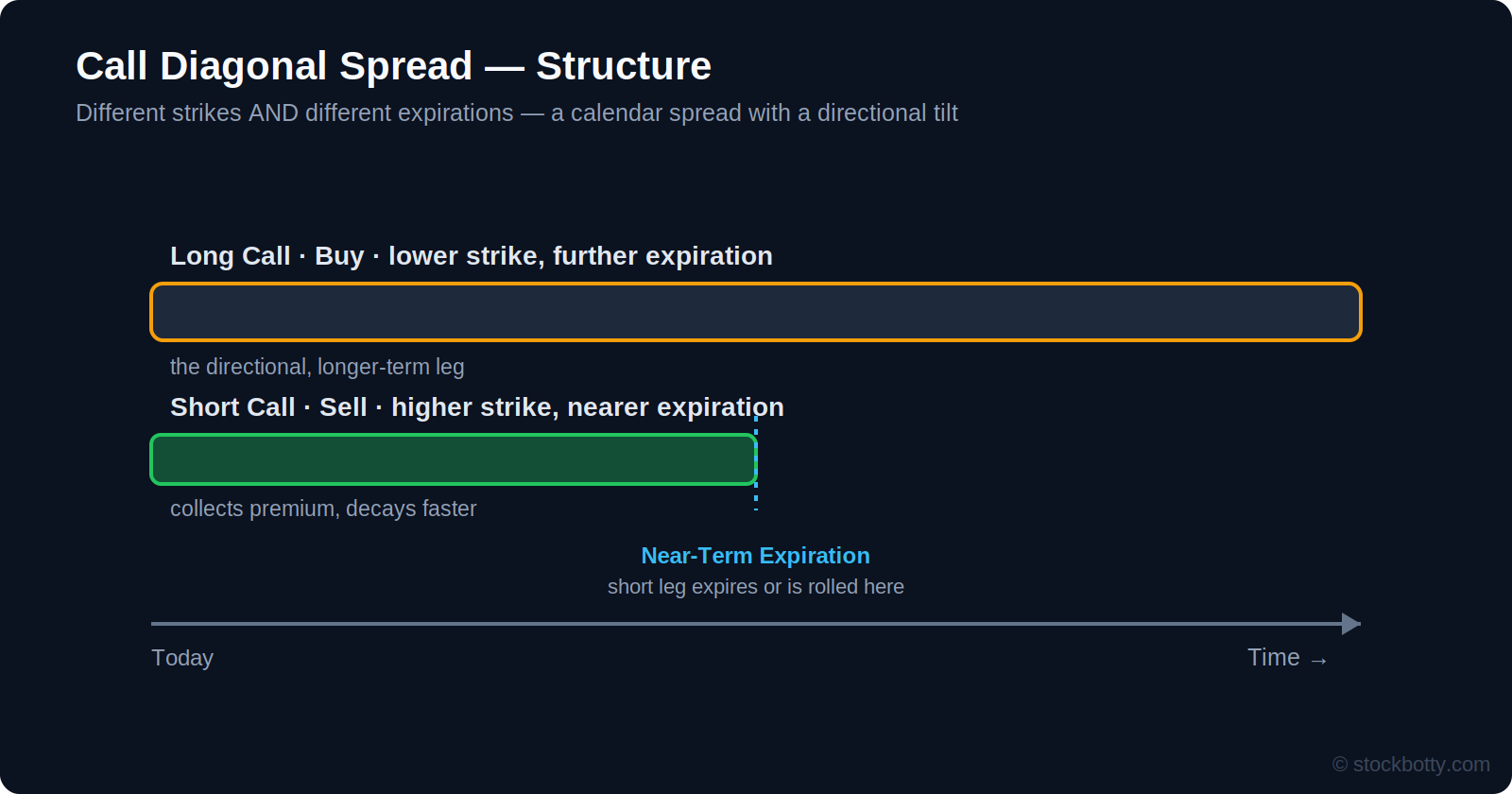
A bullish call diagonal buys a longer-dated call at a lower strike and sells a shorter-dated call at a higher strike. The short leg generates income and partially offsets the cost of the long leg, the same mechanism as a calendar spread – but because the strikes are different, the position also carries directional exposure the way a vertical spread does.
Call Diagonal vs. Put Diagonal
- Call diagonal (bullish): buy the longer-dated call at a lower strike, sell the shorter-dated call at a higher strike. Profits from a combination of the stock rising toward the short strike and the differential in time decay between the two legs.
- Put diagonal (bearish): buy the longer-dated put at a higher strike, sell the shorter-dated put at a lower strike. The mirror image, expressing a bearish view with the same time-and-strike structure.
Diagonal Spread vs. Calendar Spread vs. PMCC
These three strategies form a spectrum rather than three unrelated ideas:
- Calendar spread: same strike, different expirations – a pure time-decay trade with no directional tilt, most profitable if the stock sits near that single strike at near-term expiration.
- Diagonal spread: different strikes, different expirations – adds a directional component to the same time-decay mechanism, with the strike difference acting like a built-in bias toward the direction of the wider strike gap.
- Poor Man’s Covered Call: a diagonal spread taken to an extreme – the long leg is a deep in-the-money LEAP with a delta close to 1.00, specifically chosen to behave like owning the stock rather than like a moderate directional bet.
A moderate diagonal sits between a calendar spread’s pure neutrality and a PMCC’s near-full stock exposure – how far in the money the long leg is set determines where on that spectrum a given diagonal actually sits.
Choosing Strikes and Expiration
- Long leg strike: closer to the money or in the money for a stronger directional and stock-like tilt; further out of the money for a cheaper, more speculative directional bet.
- Short leg strike: placed above the long leg’s strike (for a call diagonal) at a level that still leaves a positive width between the two strikes, similar to the spacing considerations covered for vertical spreads.
- Expiration spacing: similar to a calendar spread, a common setup sells a near-term leg 20-30 days out against a longer-dated leg 45-90 days out or further.
When to Use a Diagonal Spread
- A directional view with a lower cost basis than an outright long option, financed partly by the shorter-dated short leg’s premium.
- A stock expected to grind toward a target level over the life of the long leg, rather than move sharply in a single burst.
- Elevated near-term implied volatility relative to longer-dated IV improves the economics, the same term-structure consideration covered for calendar spreads.
Managing the Trade
- Rolling the short leg repeatedly against the same long leg is the core management routine, identical in spirit to managing a calendar spread or a PMCC – each cycle’s premium can be collected against the same longer-dated position.
- If the stock moves toward the short strike, the short leg can be rolled up and out (for a call diagonal) to avoid capping further gains too early, the same decision covered in more detail for the covered call rescue technique in the Playbook.
- After the short leg expires, a decision has to be made whether to sell another short-term option against the long leg, hold the long leg outright, or close the position entirely.
Greeks and Volatility Behavior
- Theta: generally positive, the same mechanism as a calendar spread – the short leg decays faster than the long leg.
- Vega: generally positive on net, since the longer-dated long leg carries more vega than the shorter-dated short leg – the same dynamic covered for calendar spreads and, in more detail, for LEAPS on the LEAPS and PMCC page.
- Delta: meaningfully more directional than a calendar spread’s near-zero delta, since the two legs sit at different strikes and don’t offset each other as closely.
- Gamma: concentrated in the short leg as its expiration approaches, the same pattern covered throughout this site’s discussion of gamma risk near expiration.
Example Trade
Stock trading at $100. Buy the 90-strike call, 60 days out, for $12.50 ($1,250). Sell the 105-strike call, 25 days out, for $2.20 ($220). Net debit: $10.30 ($1,030) – the maximum loss on the position.
- If the stock rises toward $105 by the short leg’s expiration, the position benefits from both the directional move and the short leg’s faster decay.
- If the short leg expires worthless with the stock below $105, a new short-term call can be sold against the same long leg for the next cycle.
- If the stock stays flat or falls, the position behaves similarly to a calendar spread with a directional tilt working against it.
Pros and Cons
Pros: lower cost than an outright long option of the same expiration, benefits from time decay on the short leg, combines a directional view with some of the capital efficiency of a calendar spread.
Cons: more complex to manage than a single-expiration spread, requires the short leg’s strike and the stock’s path to line up reasonably well, liquidity on the further-dated leg can be thinner than near-term options.
⚠ Risks Beyond the Basics
A few points worth knowing given how closely this strategy relates to both calendar spreads and PMCCs already covered on this site.
Directional risk works both ways
Adding a directional tilt on top of a calendar spread’s time-decay mechanism means being wrong about direction can hurt in a way a pure calendar spread doesn’t experience – the position isn’t just exposed to the stock straying from a single strike, but to moving the wrong way entirely.
Early assignment and dividend risk on the short leg
The same American-style exercise risk covered throughout this site applies to the short leg of a diagonal spread, particularly around ex-dividend dates if it’s in the money with little extrinsic value left.
Liquidity on the longer-dated leg can be thin
As with LEAPS and calendar spreads, further-dated options on the same underlying often trade with wider bid-ask spreads than near-term options, affecting both entry pricing and the cost of adjusting the position later.
The decision point at every short-leg expiration requires active management
The same recurring decision covered for calendar spreads applies here – close, roll, or hold the long leg naked – and skipping that decision by default can leave an unintended directional position open longer than planned.
Frequently Asked Questions
What makes a spread diagonal?
A diagonal spread combines two features that are each used separately in other strategies: different strikes (like a vertical spread) and different expirations (like a calendar spread). Combining both is what gives the structure its name and its directional tilt.
How is a diagonal spread different from a calendar spread?
A calendar spread uses the same strike for both legs, making it a purely neutral, time-decay-driven trade. A diagonal spread uses different strikes, adding a directional component on top of the time-decay mechanism.
Is a Poor Man’s Covered Call a diagonal spread?
Yes. A PMCC is a specific, more extreme version of a call diagonal spread, using a deep in-the-money LEAP as the long leg instead of a more moderate strike, specifically to mimic the behavior of owning the stock.
Can a diagonal spread be bearish?
Yes. A put diagonal spread – buying a longer-dated put at a higher strike and selling a shorter-dated put at a lower strike – expresses a bearish view using the same time-and-strike structure as the bullish call version.
What is the maximum loss on a diagonal spread?
Typically the net debit paid to open the position, the same as a calendar spread, since the long leg’s cost usually exceeds the short leg’s premium. The exact figure depends on the specific strikes and expirations chosen.