
A covered call sells a call option against shares you already own – one contract per 100 shares. It’s one of the most widely used income strategies in options trading, and also one of the most commonly misunderstood: it’s frequently described as “safe,” when in reality it still carries nearly all the downside risk of owning the stock outright. This guide covers how it actually works, what it does and doesn’t protect against, and when it makes sense.
Structure
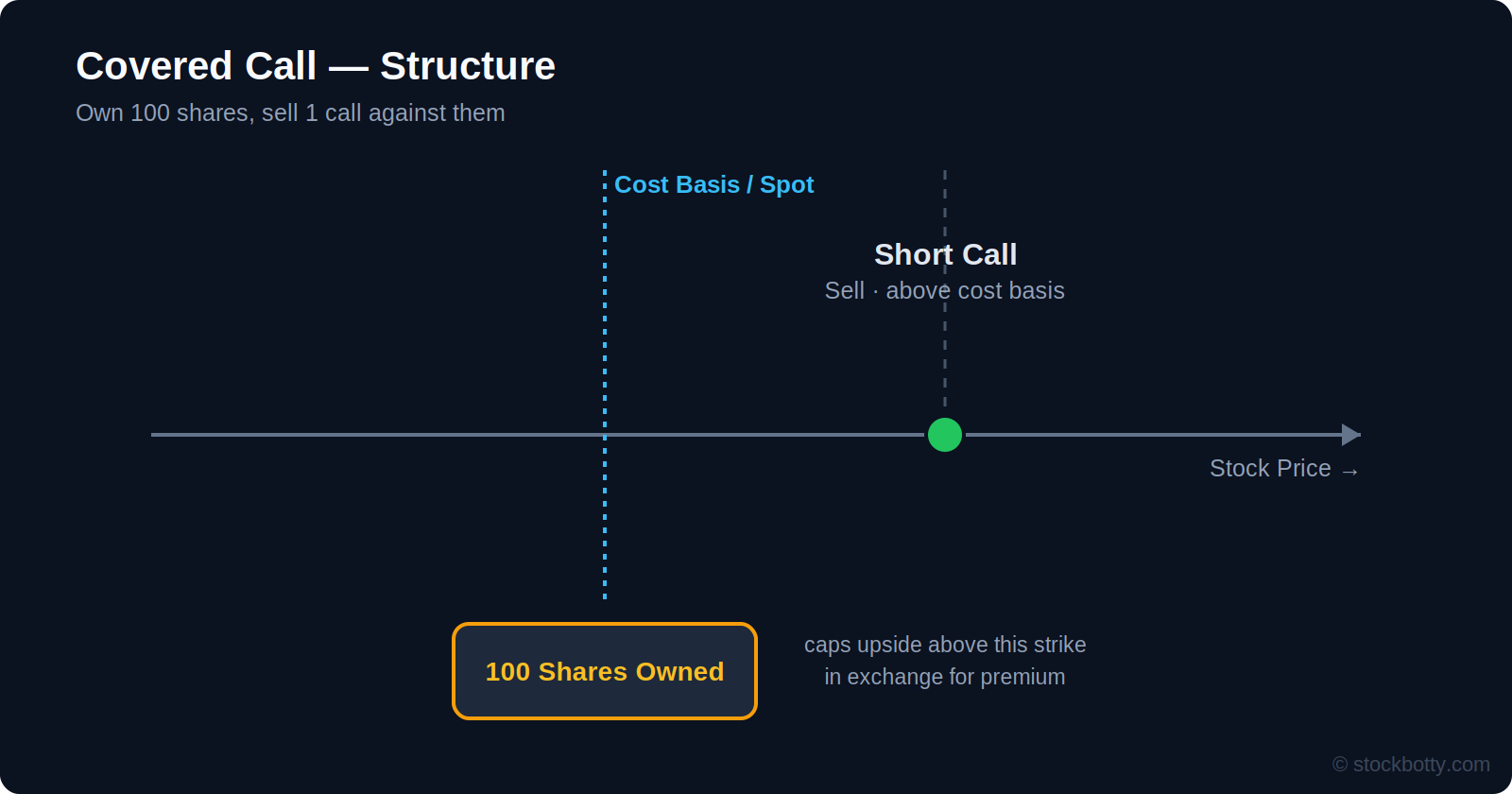
Own 100 shares of a stock, then sell 1 call option at a strike above your cost basis (or above the current price, if you’re opening the position at the same time as buying the shares). You collect the premium immediately. If the stock stays below the strike through expiration, the call expires worthless and you keep both the shares and the premium. If it finishes above the strike, your shares are sold (“called away”) at that price.
Payoff at Expiration
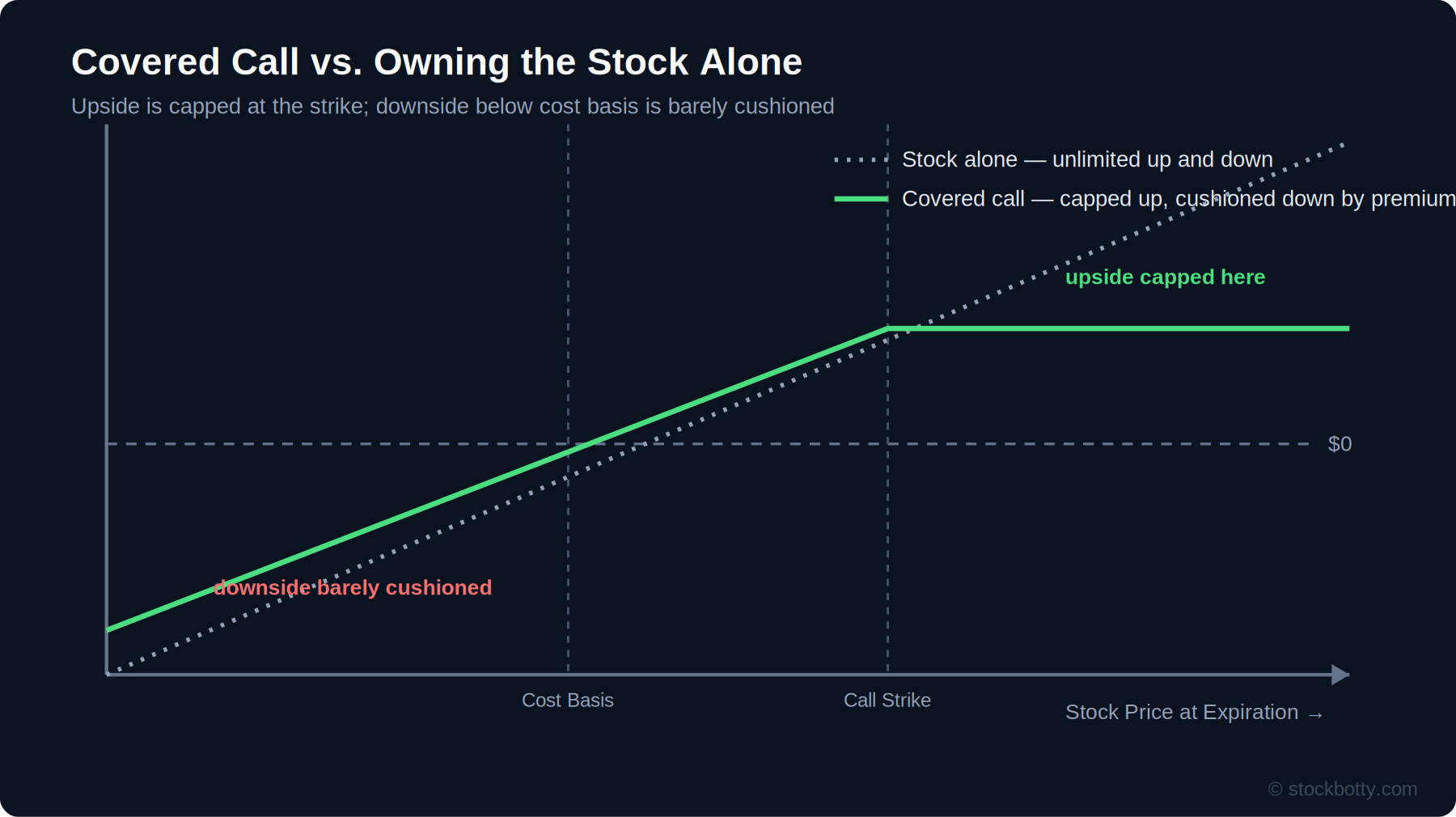
Below the strike, a covered call tracks the stock almost exactly, just shifted up slightly by the premium collected – the same downside exposure as owning the shares outright, minus a small cushion. Above the strike, the lines diverge sharply: owning the stock alone keeps climbing with no ceiling, while the covered call flattens out completely, capped at the strike plus the premium collected.
This is the trade-off in one picture: a covered call gives up unlimited upside for a small amount of downside cushioning and the premium collected. It is not a hedge against a large decline – it’s an income overlay with a ceiling.
Choosing Strikes and Expiration
- Strike selection: commonly placed using the same 20-30 delta convention used elsewhere on this site, balancing meaningful premium against the odds of the shares being called away. Selling at or above your cost basis avoids locking in a loss on the stock itself if assigned.
- Days to expiration: 30-45 days is common, the same range used for other premium-selling strategies on this site, balancing theta decay against gamma risk near expiration.
- How far above cost basis: a strike close to the current price collects more premium but caps upside sooner; a strike further out collects less premium but leaves more room for the stock to appreciate before being capped.
When to Use a Covered Call
- A neutral-to-mildly-bullish view – you’re comfortable with the stock trading sideways or rising moderately, and you’re willing to give up gains beyond the strike in exchange for income.
- Shares you’re already holding long-term – generating income against a position you’d keep either way, rather than a stock you’re trying to time a big move in.
- Elevated implied volatility generally means richer premium for the call sold, improving the income side of the trade, the same principle covered throughout this site’s other premium-selling strategies.
When I’d Think Twice: Stocks in a Strong Trend
A covered call caps the exact outcome a genuine trending stock is supposed to deliver – a large, sustained move higher. Writing calls against a stock that’s in a clear, strong uptrend means capping the upside right as it’s most likely to matter, often for a premium that’s small relative to the gain being given up. This strategy fits a stock you’re neutral to mildly bullish on far better than one you’re actually holding for a big directional move – on a genuine trend, the call premium collected can end up being a poor trade against the gains capped away.
A Tactical Variant: Writing Deep ITM to Lock In a Suspected Top
There’s one specific situation where the usual “don’t cap a trend” advice above flips: when the trend looks like it’s already topping out, not accelerating. Instead of the usual slightly out-of-the-money strike, selling a call that’s deep in the money – well below the current price – has a delta close to 1.00. Combined with the long shares, that pushes the position’s net delta close to zero, meaning it barely moves whether the stock keeps climbing or rolls over from here.
Because most of the premium collected on a deep ITM call is intrinsic value, this effectively locks in a sale price close to today’s elevated level. If the stock does turn lower as suspected, the position has already captured something close to the top rather than watching the decline erode the gain. The trade-off is real and immediate: deep ITM calls carry a high probability of early exercise, so this functions much like exiting the position now. If the stock keeps climbing instead of reversing, the gain is capped at close to today’s price, and all of the further upside is given up – a larger opportunity cost than a standard slightly-OTM covered call, since the cap sits right at the current level instead of somewhat above it.
Managing the Trade
Partial covering: you don’t have to write against every share
Covered calls are sold in whole contracts, one per 100 shares – but nothing requires writing against the full position. With 400 shares, for example, selling calls against only 200 of them (2 contracts) leaves the remaining 200 shares with full, uncapped upside, while still generating income on part of the position. This is a straightforward way to keep some trend exposure while still collecting premium on the rest, rather than facing an all-or-nothing choice between full income and full upside.
- If the stock stays below the strike, the call expires worthless, the shares are kept, and a new call can be sold for the next cycle – the same rolling routine used throughout the wheel strategy.
- If the stock rallies through the strike and you don’t want the shares called away, the call can be rolled up and out – this is covered in detail, including a full worked example, in Covered Call Rescue in the Playbook.
- If the stock falls significantly, rolling the call down can collect additional premium and lower the effective cost basis further, but it does not meaningfully change the fact that the position is still exposed to further downside.
Greeks and Volatility Behavior
- Delta: close to 1.00 from the shares themselves, partially offset by the short call’s negative delta – meaningfully less than 1.00 net, but still substantially long the stock’s movement.
- Theta: positive on the short call – the position gains value from time decay as expiration approaches, as covered in more detail on the Greeks page.
- Vega: negative on the short call – a drop in implied volatility helps the position; a rise works against the open short call.
- Gamma: concentrated near the strike as expiration approaches, the same dynamic covered throughout this site – this is when the decision to let shares go or roll the call becomes time-sensitive.
Example Trade
Stock trading at $100, cost basis $95. Sell the 105-strike call, 30-45 days out, for $2.00 ($200 per contract).
- If the stock stays below $105: keep the shares and the $200 premium, sell another call for the next cycle.
- If the stock finishes at $110: shares are called away at $105 – a $10 gain per share from cost basis ($1,000), plus the $200 premium, but none of the additional $5 the stock moved past the strike.
- If the stock falls to $85: the position is down $10 per share from cost basis ($1,000), offset only by the $200 premium collected – a $800 net loss on the position, nearly identical to holding the shares alone.
Pros and Cons
Pros: generates income on shares already held, benefits from time decay, straightforward to understand and execute, can be repeated cycle after cycle for ongoing income.
Cons: upside is capped, meaning a big rally is only partially captured; downside is barely cushioned, meaning a large decline is still mostly absorbed in full; ties up 100 shares of capital per contract in a single name.
⚠ Risks Beyond the Basics
Covered calls are often introduced as a low-risk income strategy. A few points worth being precise about before treating it that way.
“Covered” refers to the call, not to your downside
The term describes the fact that the short call is backed by real shares, not that the overall position is protected from loss. A covered call’s maximum loss is only marginally smaller than simply holding the stock – the premium collected is a small cushion, not meaningful downside insurance.
Early assignment and dividend risk
Since equity options are American-style, an in-the-money short call with little extrinsic value left can be exercised early, particularly around an ex-dividend date, when the call holder may exercise specifically to capture the dividend.
Opportunity cost during a strong rally
A stock that gaps or runs well past the strike caps the covered call seller’s gain at exactly the point where an uncovered shareholder would have benefited the most. Selling calls too close to the current price, too often, can mean consistently leaving significant upside on the table.
Concentration risk from tying up 100 shares per contract
Running covered calls meaningfully increases the capital committed to a single name compared to a defined-risk options strategy covering the same notional exposure – worth weighing against how diversified the rest of a portfolio is.
Weekend and overnight gap risk on the downside remains fully in effect
Since the position is barely cushioned below cost basis, a large overnight gap down on unexpected news affects a covered call almost exactly the way it would affect the shares alone.
Frequently Asked Questions
What is a covered call?
A strategy where you sell a call option against shares you already own, one contract per 100 shares. You collect a premium up front, in exchange for capping your upside at the strike price if the stock rallies past it.
Is a covered call a safe strategy?
It’s often described that way, but it isn’t risk-free. A covered call still carries nearly all the downside risk of owning the stock outright, cushioned only by the premium collected. It reduces risk slightly and caps the upside meaningfully – it doesn’t protect against a large decline.
What is the maximum profit on a covered call?
The difference between the strike price and your cost basis, plus the premium collected. This is realized if the stock finishes at or above the strike at expiration and the shares are called away.
What happens if the stock falls after I sell a covered call?
You still own the shares and participate in the decline, offset only by the premium you collected. A covered call does not meaningfully protect against a large drop in the stock.
How is a covered call different from a cash-secured put?
A cash-secured put is typically used before owning the stock, to potentially acquire it at a discount. A covered call is used after owning the stock, to generate income and set a target sale price. The wheel strategy cycles between the two.
Do I have to sell a covered call against all of my shares?
No. Covered calls are sold in whole contracts, one per 100 shares, but nothing requires covering the entire position. Writing against only part of a larger holding leaves the rest with uncapped upside while still generating some income.
What does writing a deep in-the-money covered call do?
It brings the position’s net delta close to zero, since a deep ITM call’s delta is close to 1.00. This effectively locks in a sale price near the current level, which can be useful if a trend is suspected to be topping out – at the cost of giving up all further upside if the stock keeps climbing instead.